
Background on AI:
Large language models have made conversational interaction with computers a practical part of education, software development, research, and creative work. These systems can explain a chemistry problem, suggest revisions to a narrative, or identify an error in a computer program, often producing responses with considerable fluency and sensitivity to context. Their apparent command of language raises a fundamental technical question: how can a computational system generate such varied and coherent responses? A language model operates through mathematical transformations implemented on computer hardware. Its capabilities develop through training, during which large numbers of numerical parameters are adjusted to capture patterns in data. Although its responses may resemble those of a knowledgeable person, that resemblance does not establish that its internal processes or experiences are comparable to human cognition. Understanding the technology therefore requires examining the mechanisms that produce its behavior. This article follows the development of language modeling from early translation systems and statistical methods through word embeddings, recurrent networks, attention, and transformers. It then examines training, text generation, human feedback, limitations, and the broader implications of deployment. A central theme connects these developments: predicting the continuation of language can require representations of increasingly complex relationships. The prediction objective is relatively straightforward; the capabilities that can develop through training are considerably more difficult to characterize. The history of the field explains both how this approach became possible and why significant questions remain about its reliability and interpretation.
The effort to process language computationally begins with the characteristics of language itself. Reading and listening involve much more than recognizing individual words. A reader must identify grammatical relationships, follow references across sentences, interpret implied meaning, and distinguish literal statements from requests, irony, or exaggeration. These operations depend on context and background knowledge. Language therefore cannot be treated as a simple substitution code in which each symbol has one fixed meaning. The word “bank,” for example, may refer to a financial institution or the land beside a river. The sentence “Can you pass the salt?” ordinarily functions as a request, even though its grammatical form asks about ability. Emphasizing different words in “I never said she stole my money” changes which part of the statement is being disputed. Such examples illustrate several interacting forms of ambiguity: the meaning of individual words, the structure of sentences, the speaker’s intention, and the relationship between an utterance and its circumstances. People resolve these ambiguities using knowledge of the physical world, social conventions, previous conversation, and other people’s likely intentions. A computational language system must account for enough of these relationships to produce useful interpretations and responses. Early systems demonstrated that identifying vocabulary and grammatical rules was only part of the problem. The broader challenge was representing the information that allows the same words to communicate different meanings in different settings. That challenge would influence each subsequent stage of language technology, from manually specified rules to statistical models and learned representations.
Machine translation provided one of the earliest major applications of computational language processing. During the early Cold War, the demand to translate Russian scientific and technical material encouraged research into automated methods. Warren Weaver’s 1949 memorandum proposed connections between translation, cryptography, and the statistical properties of language. The proposal helped establish translation as a serious computing problem. In 1954, IBM and Georgetown University demonstrated a system that translated a carefully selected set of Russian sentences into English using a small vocabulary and a limited collection of grammatical rules. The demonstration showed that a computer could perform a constrained translation task, but extending that achievement to unrestricted language proved substantially more difficult. Natural language contains overlapping grammatical patterns, idioms, ambiguous words, and exceptions whose interpretation depends on context. Adding a rule to handle one construction could introduce errors in another. Expanding a dictionary could increase ambiguity as well as coverage. Systems could produce sequences of valid English words while failing to preserve the meaning of the original sentence. These difficulties persisted despite sustained research, and the 1966 report of the Automatic Language Processing Advisory Committee, commonly known as ALPAC, criticized the practical progress and economics of machine translation. Its conclusions contributed to a major reduction in United States funding for the field. The experience exposed a limitation of an approach based primarily on manually specifying linguistic rules. Grammar provides essential structure, but a complete account of meaning also requires knowledge of usage, context, and the world being described. The expression “I could care less,” for example, often communicates indifference despite its literal wording. A comment about an expensive car may convey admiration, criticism, or a threat depending on the circumstances. These differences cannot be resolved by grammatical analysis alone. The limitations of early translation systems did not demonstrate that linguistic rules were irrelevant; they showed how difficult it was to enumerate all the information needed for unrestricted language use. This distinction helped motivate approaches that learned regularities directly from examples.
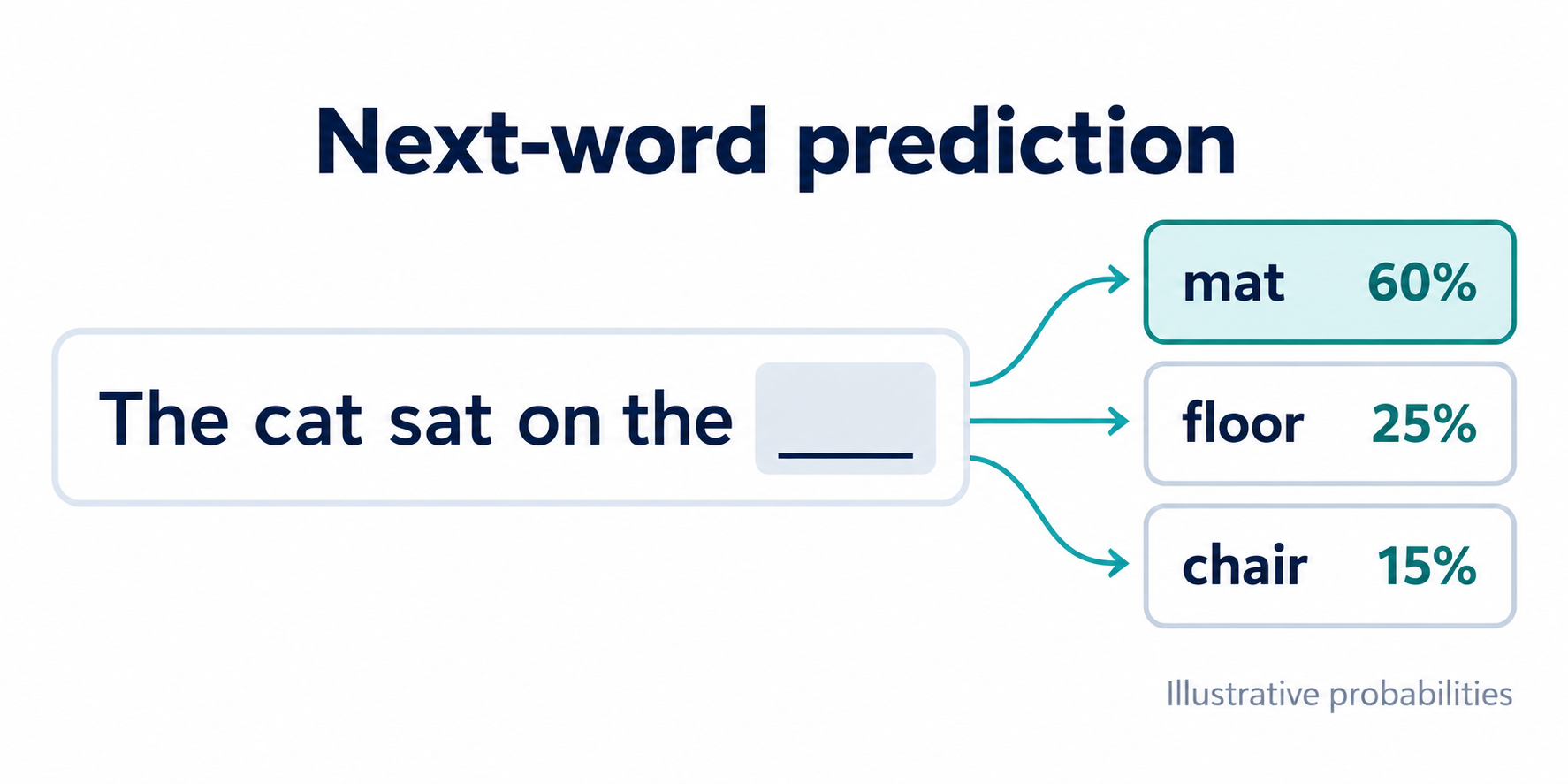
A complementary approach emerged from information theory. Claude Shannon’s 1948 paper, “A Mathematical Theory of Communication,” established a mathematical framework for measuring information and analyzing communication channels. Among its examples were statistical approximations to written language. Shannon considered how increasingly detailed estimates of symbol frequencies could produce text with progressively more recognizable structure. Selecting letters independently and with equal probability yields sequences with little resemblance to English. Weighting letters by their observed frequency produces a closer approximation: common letters occur frequently, while uncommon letters appear less often. Conditioning each selection on the preceding letter captures additional structure. After “q,” for example, “u” is a common continuation in English. Conditioning on still longer preceding sequences captures more local patterns. The same principle applies to words. A model that chooses words independently according to their frequency may generate common vocabulary without coherent ordering. A model that considers the previous word can produce familiar combinations, while a model that considers two previous words can reproduce longer fragments. These are examples of unigram, bigram, and trigram models. Shannon’s generated sequences demonstrated a gradual transition from isolated symbols toward recognizable phrases as more statistical context was incorporated. They did not establish that simple frequency models understood the material they generated. They showed that measurable regularities in language could reproduce aspects of its form without an explicit inventory of grammatical rules. This provided an important conceptual foundation for language modeling: the probability of a continuation depends on what precedes it. The more effectively a model represents that relationship, the better it can approximate the patterns found in actual text.
The predictive approach was compelling, but early statistical models faced severe limits as their context expanded. An n-gram model estimates probabilities from sequences of n items, using the preceding n minus one items to predict the next. With a vocabulary of 50,000 words, there are 2.5 billion possible word pairs and 125 trillion possible three-word sequences. Most such combinations will be rare or absent in any available collection of text. Storing and estimating separate probabilities for increasingly long sequences therefore becomes impractical. This problem of sparse data restricts the ability of straightforward counting methods to capture long dependencies. A short sequence may contain enough information to predict a common phrase, but it may omit the person to whom a pronoun refers, a qualification introduced earlier, or the argument being developed across several paragraphs. Statistical models can consequently reproduce local linguistic patterns while failing to maintain a coherent account of the larger passage. These limitations formed part of a wider debate about how language should be studied and represented. Approaches emphasizing formal structure sought explicit accounts of grammar, meaning, and logical relationships. Noam Chomsky’s work on generative grammar was especially influential in arguments that a theory of language must explain structural properties beyond observed word frequencies. His proposals concerning innate linguistic capacities also shaped research on language acquisition and cognition. Empirical approaches placed greater emphasis on regularities recoverable from actual language data. Although this division was never absolute, it reflected a substantial difference in research priorities: explaining the formal organization of language and developing statistical methods capable of predicting or processing it. Subsequent advances would draw on questions raised by both traditions, even as the availability of data made statistical methods increasingly effective.
Statistical language processing gained practical momentum as researchers developed methods that could learn from larger collections of text and speech. At IBM, work on statistical machine translation used parallel corpora, including corresponding French and English documents, to estimate relationships between the languages. The resulting systems learned translation probabilities and alignment patterns from examples rather than requiring every correspondence to be written as a rule. Their performance demonstrated that substantial translation capability could emerge from probabilistic modeling of data. Similar developments occurred in other applications. Hidden Markov models provided a framework for learning relationships between speech signals and linguistic sequences. Probabilistic classifiers improved the identification of unwanted email. Statistical methods also became central to information retrieval and the ranking of search results. Across these applications, data supplied evidence about patterns that would be difficult to specify comprehensively by hand. This progress did not eliminate the need for expert design. Many systems still relied on features selected by engineers: word pairs, suffixes, capitalization, grammatical labels, or other measurable properties. The model could learn how much importance to assign to those features, but the choice of representation constrained what it could discover. A system might perform well when its designers identified the right signals and poorly when relevant information was omitted. This dependence on feature engineering became a significant limitation. The next major development would allow a model to learn useful internal representations as part of the task itself. Instead of relying entirely on a predetermined description of language, the training process could adjust the numerical form in which words and relationships were represented. That change required addressing a basic issue underlying every computational language system: how linguistic symbols should be converted into numbers.
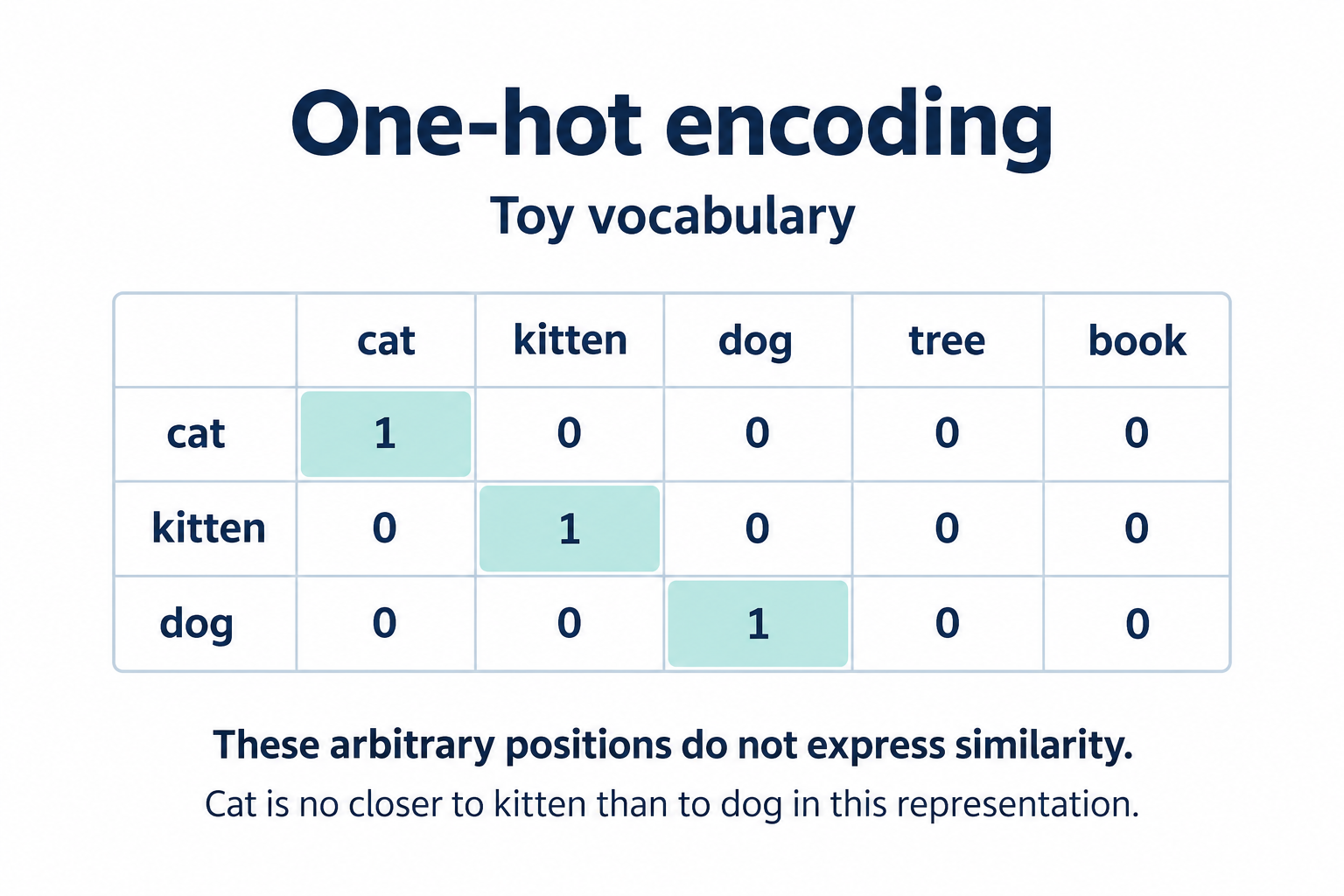
A computer must represent words numerically before a neural network can process them. Assigning a unique integer to each word provides an identifier, but the numerical distance between identifiers has no linguistic meaning. If “cat” receives one number and “dog” another, their relationship cannot be inferred from how close those numbers happen to be. One-hot encoding avoids this misleading ordering by assigning each word a vector with one position for every item in the vocabulary. All entries are zero except the entry corresponding to that word, which is one. In a vocabulary of 50,000 words, each conceptual vector therefore has 50,000 positions. Sparse implementations can store such identifiers efficiently, but the representation itself contains no graded similarity between words. Every pair of distinct one-hot vectors is equally separated under the usual Euclidean distance. “Cat” is consequently no closer to “kitten” than it is to “democracy.” This representation distinguishes symbols without expressing how they are related. A language model can still learn useful relationships from those identifiers, but the identifiers alone provide no shared semantic structure. A more useful representation would capture similarities in usage and allow knowledge associated with one word to support predictions involving related words. Words referring to similar objects, appearing in comparable grammatical roles, or participating in related concepts should have numerical representations that reflect some of those connections. Learning such representations became a central contribution of neural approaches to language.
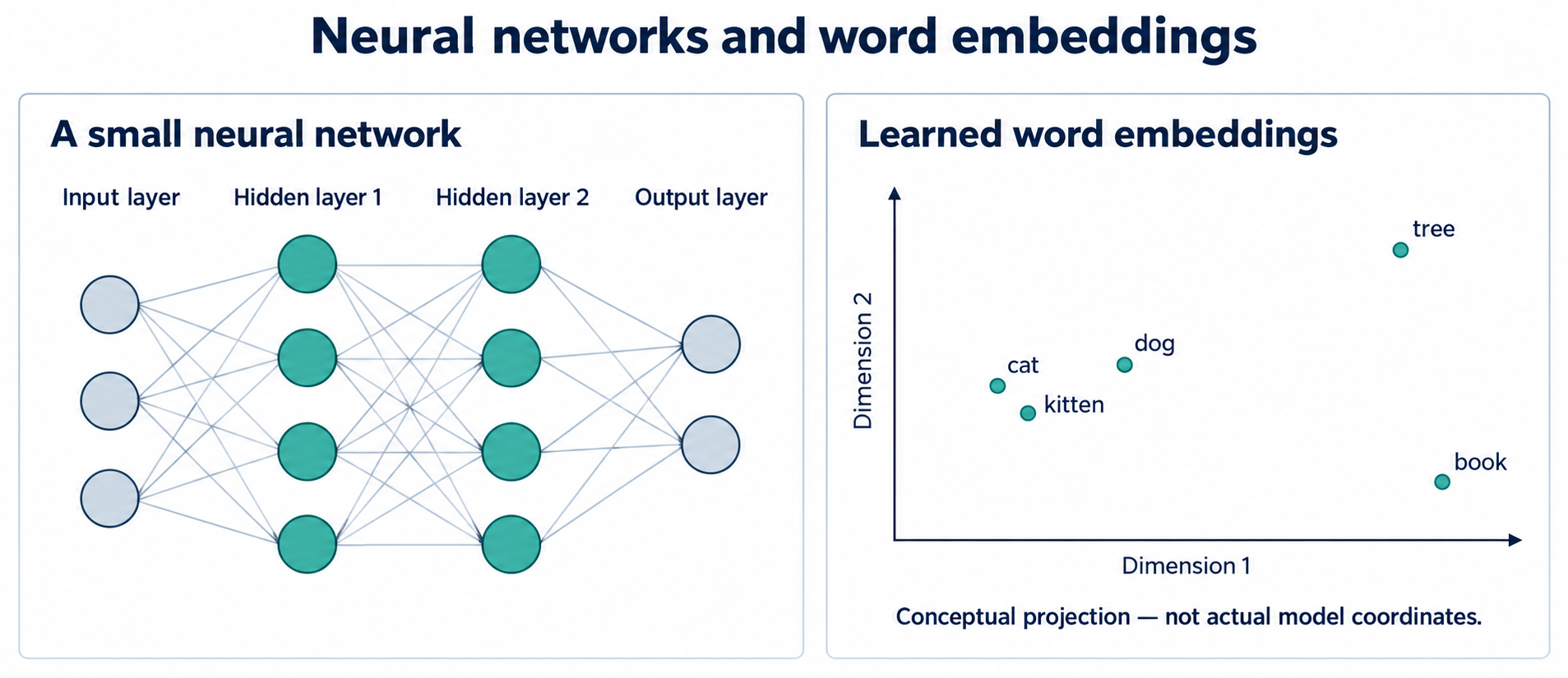
Learned word embeddings address this problem by representing each word as a dense vector whose values are adjusted during training. A vector might contain a few hundred numbers rather than one entry for every word in the vocabulary. Its initial values need not carry linguistic information; the training objective shapes them as the network learns to predict language. Neural language modeling research, including work by Yoshua Bengio and colleagues, helped establish this approach. Word2vec, introduced by Tomas Mikolov and colleagues in 2013, made the construction of useful word vectors practical on large text collections. Its two principal training methods use local context. Skip-gram predicts surrounding words from a target word, while continuous bag of words predicts a target word from surrounding words. These tasks require no dictionary definitions for each concept. Instead, words that occur in comparable contexts develop related representations. The resulting geometry can capture both similarity and certain recurring relationships. Words associated with animals may occupy related regions, while differences between vectors can reflect patterns involving countries and capitals, grammatical forms, or gendered terms. A widely used demonstration is the approximate relationship “king minus man plus woman,” which can produce a vector close to “queen” in some embeddings. Such results are illustrative rather than universal algebraic identities; they depend on the training data, model, and evaluation method. Their importance lies in showing that relationships expressed repeatedly in text can become measurable relationships among vectors. The model has not been supplied with a formal definition of royalty or an explicit rule for every analogy. It has learned numerical regularities that support some of those comparisons. This approach provided a way for linguistic information to be distributed across many dimensions, with each word participating in multiple overlapping relationships. It also showed why the training corpus matters: the representations can reflect useful regularities, cultural assumptions, and biases present in the language from which they are learned.
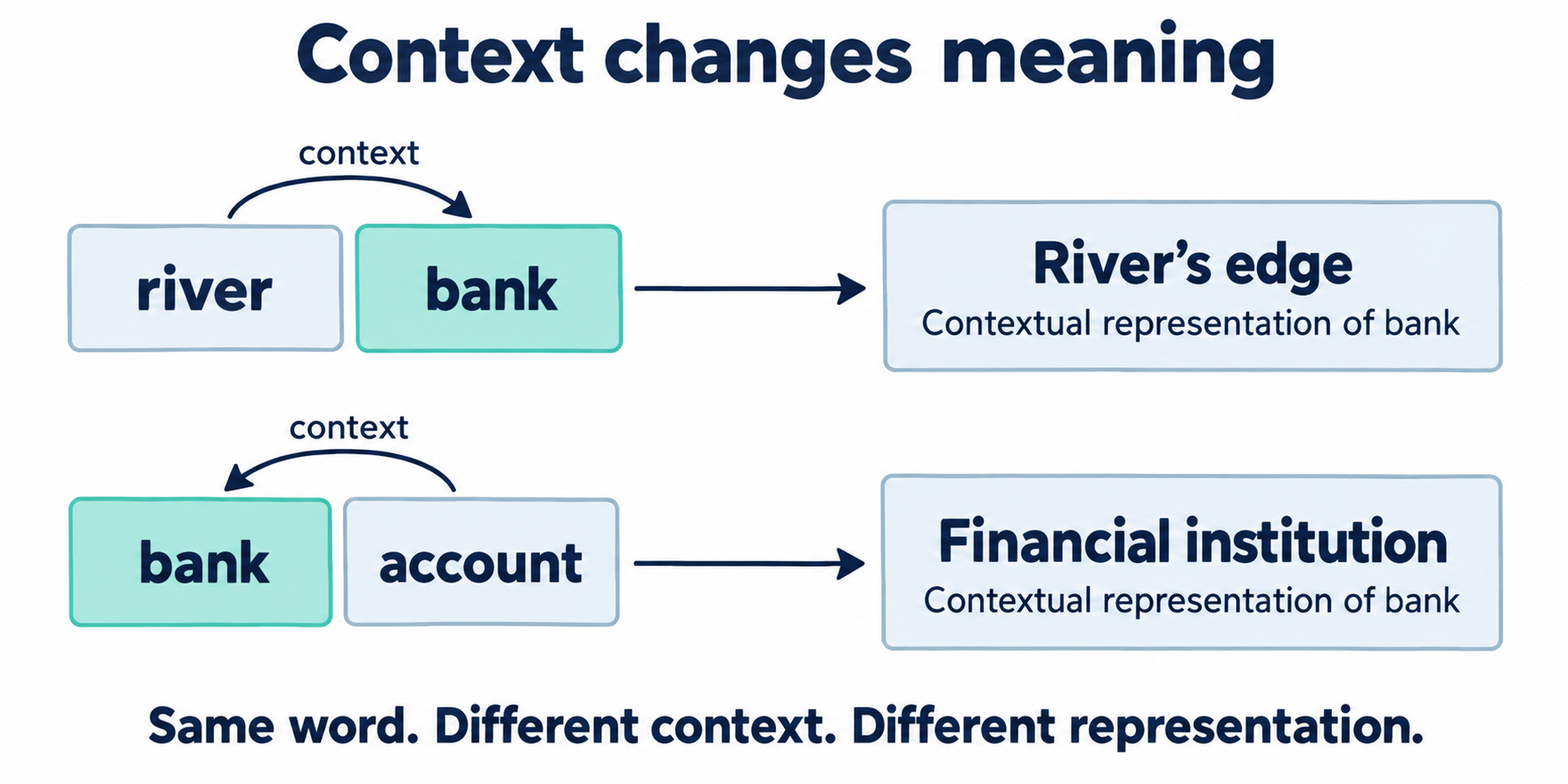
Word embeddings changed how representations could be reused across language tasks. A sentiment classifier, for example, could begin with vectors learned from a large general text collection and then use labeled reviews to learn the distinction between positive and negative sentiment. This reduced the need to design every input feature specifically for that application. Related approaches, including GloVe, developed by Jeffrey Pennington, Richard Socher, and Christopher Manning, used global word co-occurrence statistics to construct embeddings. These methods gave practical form to the distributional view of meaning: the contexts in which a word appears contain information about its use and relationships. They also supported transfer between tasks, because a representation learned from one collection could be useful in another setting. The resulting vectors remained limited, however, by their treatment of context. A conventional word embedding assigns one vector to a word regardless of where it occurs. “Bank” therefore receives the same representation in a discussion of river erosion and in a discussion of savings accounts. A downstream system may use surrounding words to distinguish those meanings, but the static embedding itself does not change. This creates difficulty for ambiguous words and for expressions whose interpretation depends on the sentence as a whole. A more capable model needs to produce a representation conditioned on the particular passage being processed. The objective shifts from representing a word in general to representing that word as it is used at a specific point in a sequence. This requirement leads directly to contextual representations and to architectures designed to process dependencies across text.
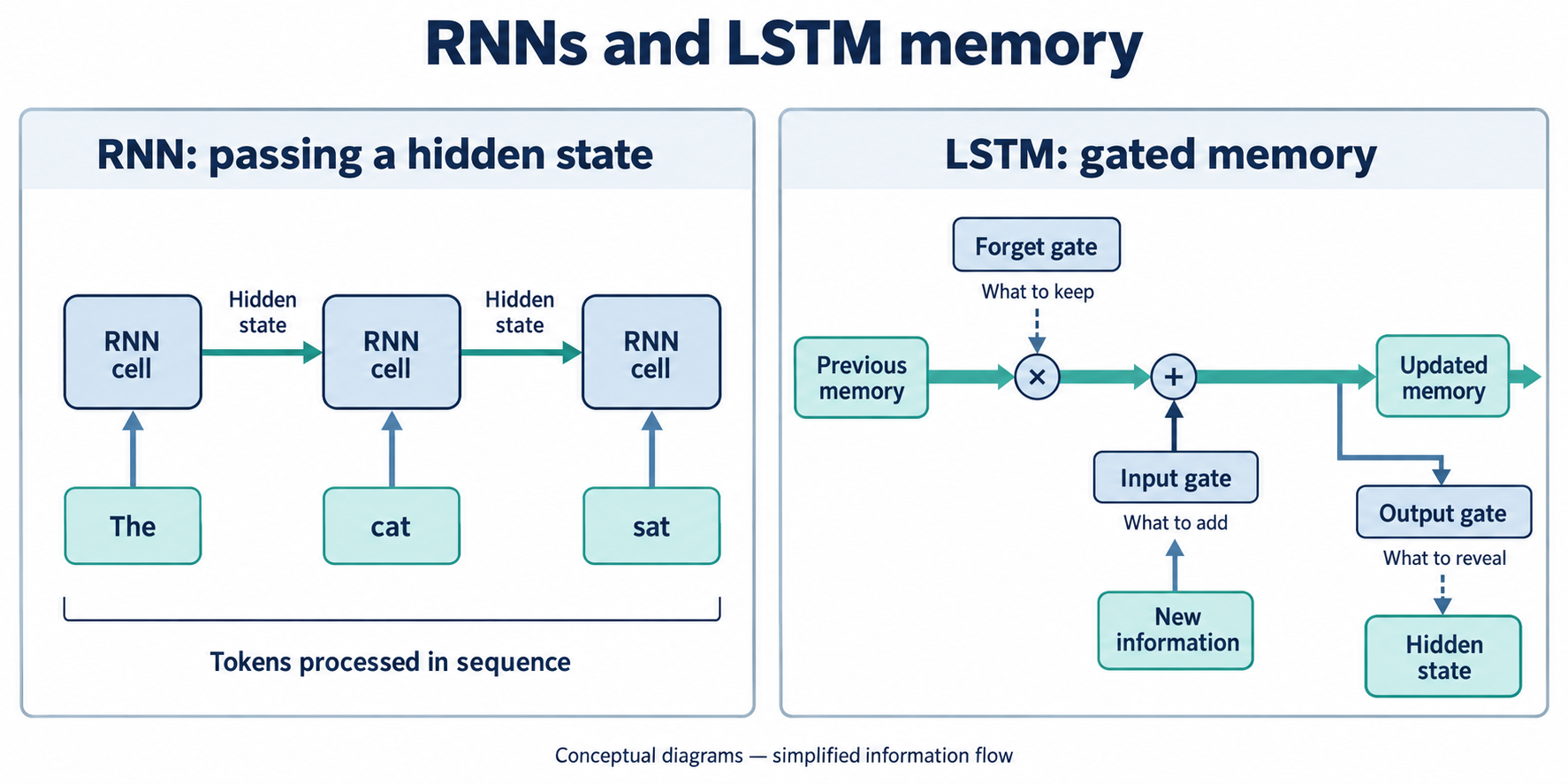
Recurrent neural networks, or RNNs, provide one way to build representations that depend on earlier parts of a sequence. At each step, the network processes an input together with a hidden state carried forward from the preceding step. The updated state serves as a compressed representation of information available so far. This allows the same network to process sequences of different lengths and to make predictions influenced by preceding words. Recurrent architectures supported advances in language modeling, speech recognition, and translation, but retaining information across long sequences proved difficult. During training, error signals must propagate backward through repeated transformations. Depending on the values involved, these gradients can become extremely small or large, making long dependencies difficult to learn. A fixed-size hidden state also has limited capacity to preserve details from an extended passage. Long short-term memory networks, or LSTMs, developed by Sepp Hochreiter and Jürgen Schmidhuber, introduced a memory structure designed to improve the preservation of information across time steps. In widely used LSTM formulations, learned gates regulate the admission of new information, the retention or removal of existing information, and the information exposed as output. The cell state provides a path along which relevant information can persist more effectively than in a basic RNN. LSTMs became important components of sequence models, including neural translation systems. Their success demonstrated the value of learning what to retain rather than treating every preceding input equally. Nevertheless, recurrent computation retains a sequential dependency: processing a later position requires the state produced at an earlier one. This restricts parallel execution across positions and can make training lengthy sequences expensive. Distant information must also pass through a succession of state updates before it influences a later prediction. Improved memory alleviates that difficulty without removing the underlying communication path. Translation research provided a setting in which these limitations were especially visible, because producing each part of a target sentence may require access to a different part of the source.
An LSTM processes a sequence one item at a time while carrying forward an internal memory called the cell state. At each step, learned gates control which information is retained, updated, or discarded. This allows information introduced early in a sequence to influence the processing of items much later in that sequence. The connection is maintained by preserving information through the intervening steps, rather than by moving directly back and forth between distant items.
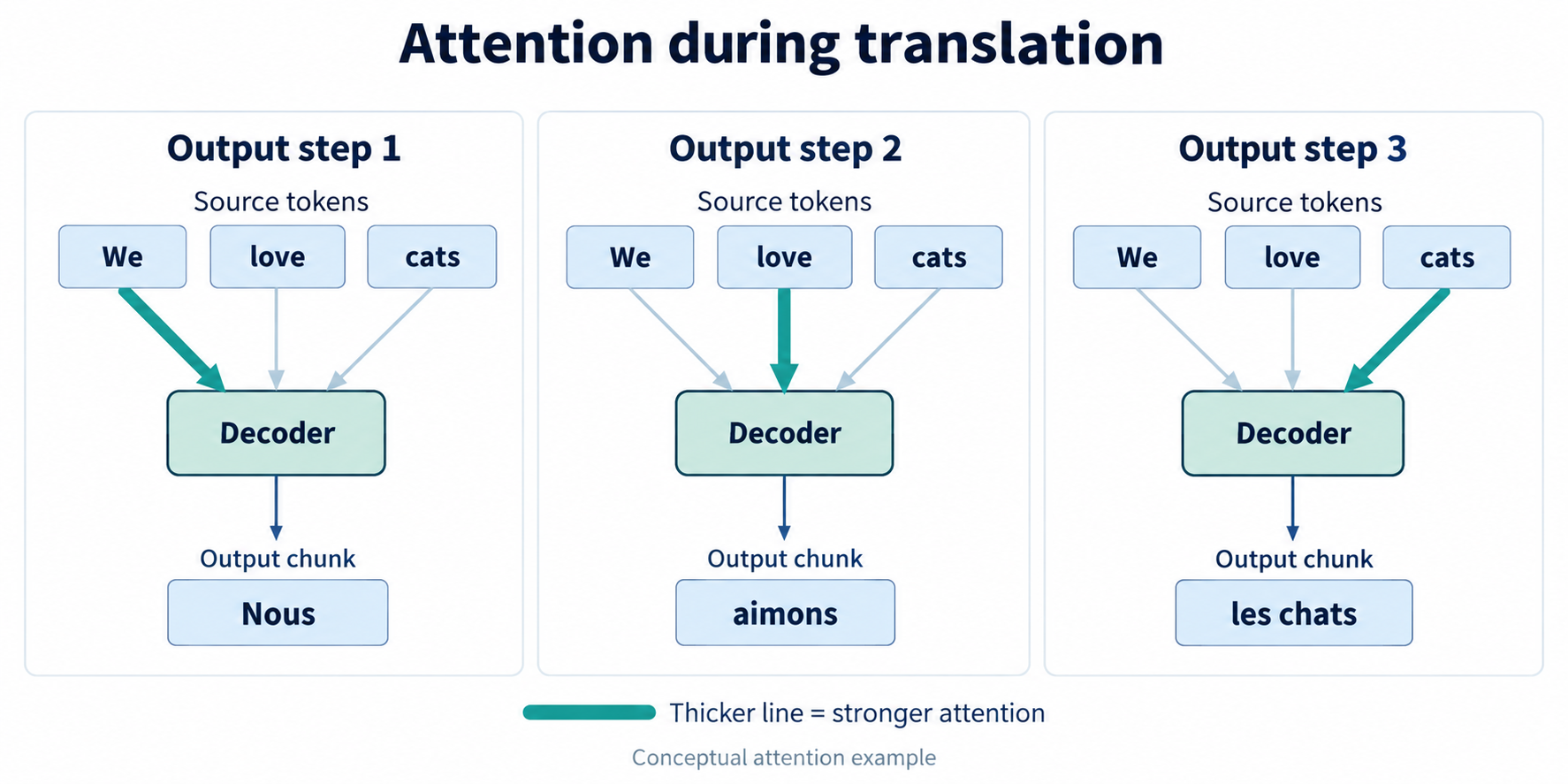
Early neural translation systems often used an encoder and a decoder. The encoder processed the source sentence and compressed its information into a fixed-size representation. The decoder then used that representation to generate the translated sentence. Sequence-to-sequence research, including work by Ilya Sutskever, Oriol Vinyals, and Quoc Le, demonstrated the potential of this arrangement. Its limitation was the requirement to preserve the information needed for an entire translation in a single compressed state. A longer or more complicated sentence placed greater demands on the same representational capacity. Attention offered a way to reduce this bottleneck. Work by Dzmitry Bahdanau, Kyunghyun Cho, and Yoshua Bengio introduced a translation mechanism that allowed the decoder to consult representations of different source positions while generating each part of the output. At a given decoding step, the model calculated relevance scores for the available source representations. It normalized those scores into weights and used them to construct a weighted combination of source information. The relevant source context could therefore change as the translation progressed. A word near the end of the source sentence could contribute directly when needed, without requiring all of its information to survive in the final encoder state. This approach also accommodated the differences in word order between languages: the decoder could draw on source positions in an order appropriate to the target language. Attention initially supplemented recurrent networks, but its broader implications extended beyond translation. It provided a learned mechanism for connecting positions according to their relevance. The distance between two positions no longer determined how many intermediate states information had to traverse through the attention connection. This suggested that attention itself could perform much of the sequence processing previously assigned to recurrence. That possibility became the foundation of the transformer.
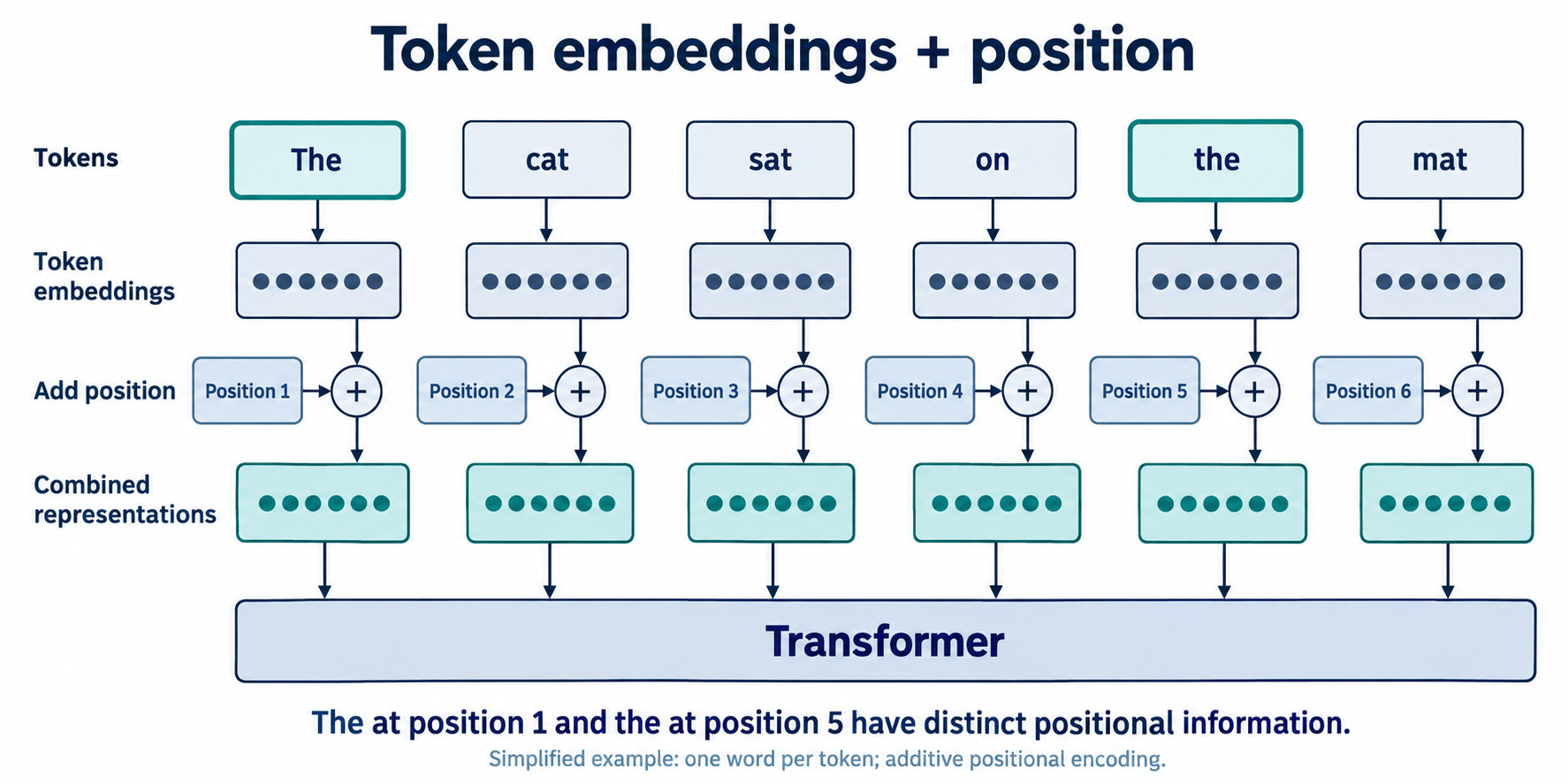
The 2017 paper “Attention Is All You Need,” by Ashish Vaswani, Noam Shazeer, Niki Parmar, Jakob Uszkoreit, Llion Jones, Aidan Gomez, Łukasz Kaiser, and Illia Polosukhin, introduced the transformer architecture. Its central contribution was a sequence model that used attention without recurrent or convolutional layers. This allowed representations at multiple positions to be computed in parallel during training, substantially reducing the sequential bottleneck associated with recurrent networks. The architecture still processes information through successive layers, and autoregressive generation still produces tokens in sequence; removing recurrence does not eliminate every form of sequential computation. To understand the architecture, consider how it represents an input sentence. Each token is mapped to an embedding, a learned vector of numbers. Because attention alone does not establish the order of the inputs, positional information must also be supplied. The original transformer used positional encodings based on sine and cosine functions at different frequencies. These signals gave the model information about where tokens occurred and supported comparisons involving their relative positions. Other transformer designs can represent position differently. Within an attention layer, learned linear transformations produce three vectors for each position: a query, a key, and a value. These names describe their roles in the computation. The query determines what information a position seeks; keys provide features against which queries are compared; values contain the information combined according to the resulting weights. These roles are mathematical operations learned through training. They do not require a separate, explicit question or a manually assigned description for each word. The network adjusts the transformations so that the information exchanged among positions helps it perform its training task. This mechanism forms the core of self-attention, in which the queries, keys, and values are derived from representations within the same sequence.
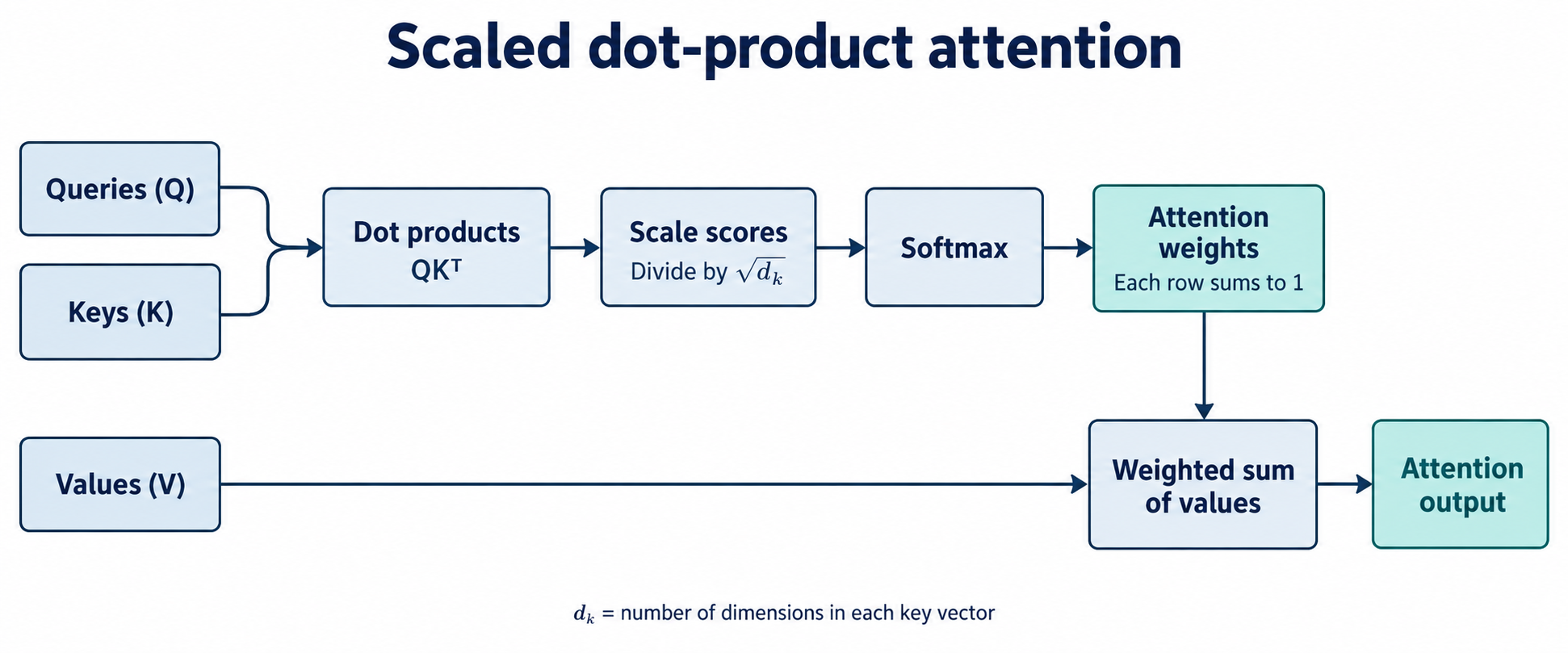
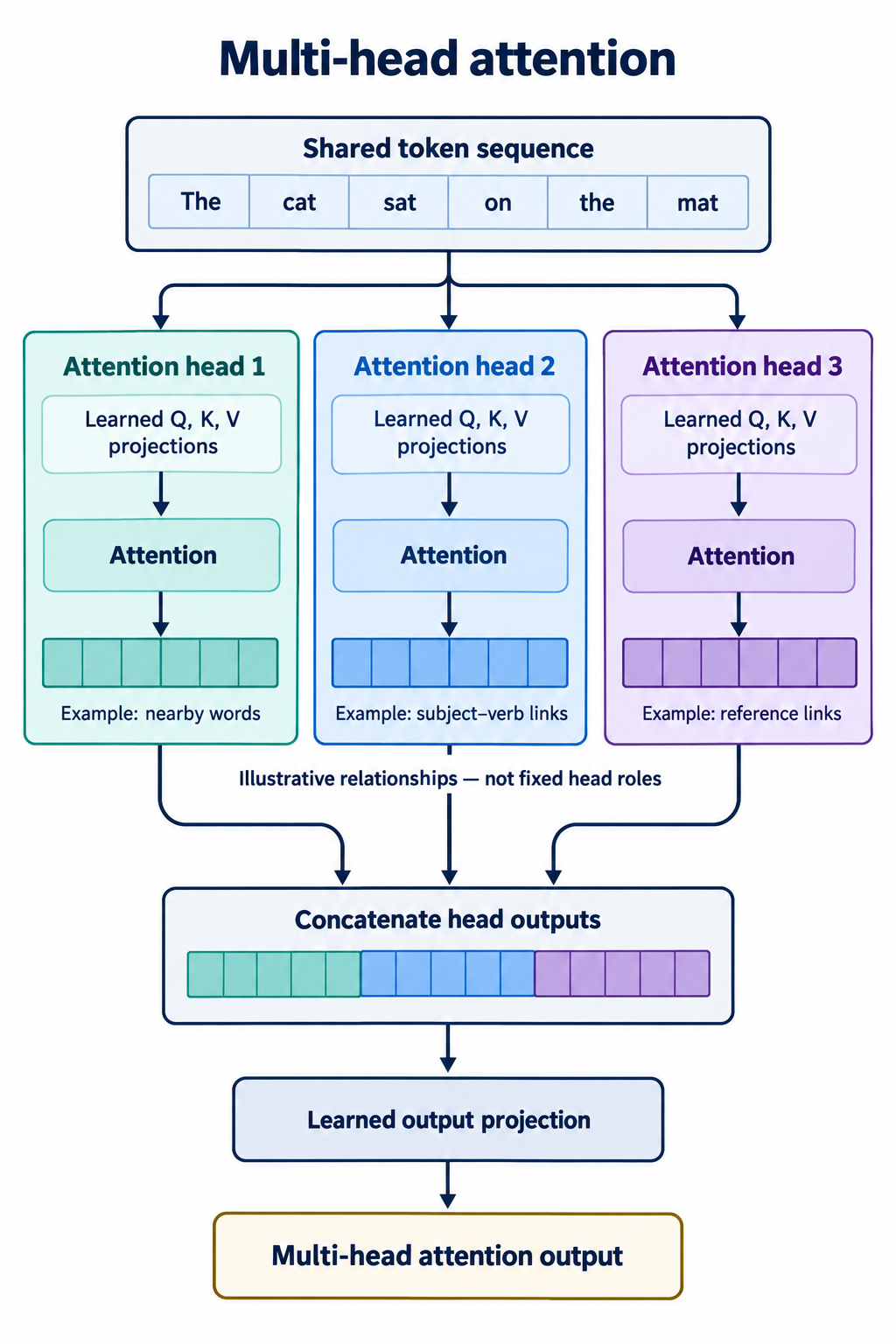
Scaled dot-product attention calculates a compatibility score between a query and each available key. The dot product measures how the two vectors align. Dividing these scores by the square root of the key dimension helps control their scale before the softmax operation converts them into nonnegative weights that sum to one. The attention output is the weighted sum of the value vectors. Positions with higher weights contribute more strongly to the result. Which positions are available depends on the attention mask: a decoder generating text must be prevented from using future tokens during training, while an encoder may use context from both directions. The mechanism can support relationships such as pronoun reference, grammatical agreement, and the interpretation of ambiguous words. In the sentence “The dog did not cross the street because it was too wide,” the surrounding words support an interpretation in which “it” refers to the street. A transformer can use information about those words and their relationships to represent that interpretation. This example illustrates the kind of dependency attention can help capture; it does not imply that a particular head must assign one specific weight or that an attention diagram alone fully explains the model’s reasoning. The query, key, and value transformations are all learned, allowing the network to discover which comparisons and information transfers are useful. A single attention operation, however, has limited capacity to represent every relevant relationship simultaneously. Transformers therefore use multiple attention heads, each with its own learned projections, so that several patterns of interaction can contribute to the representation at each position.
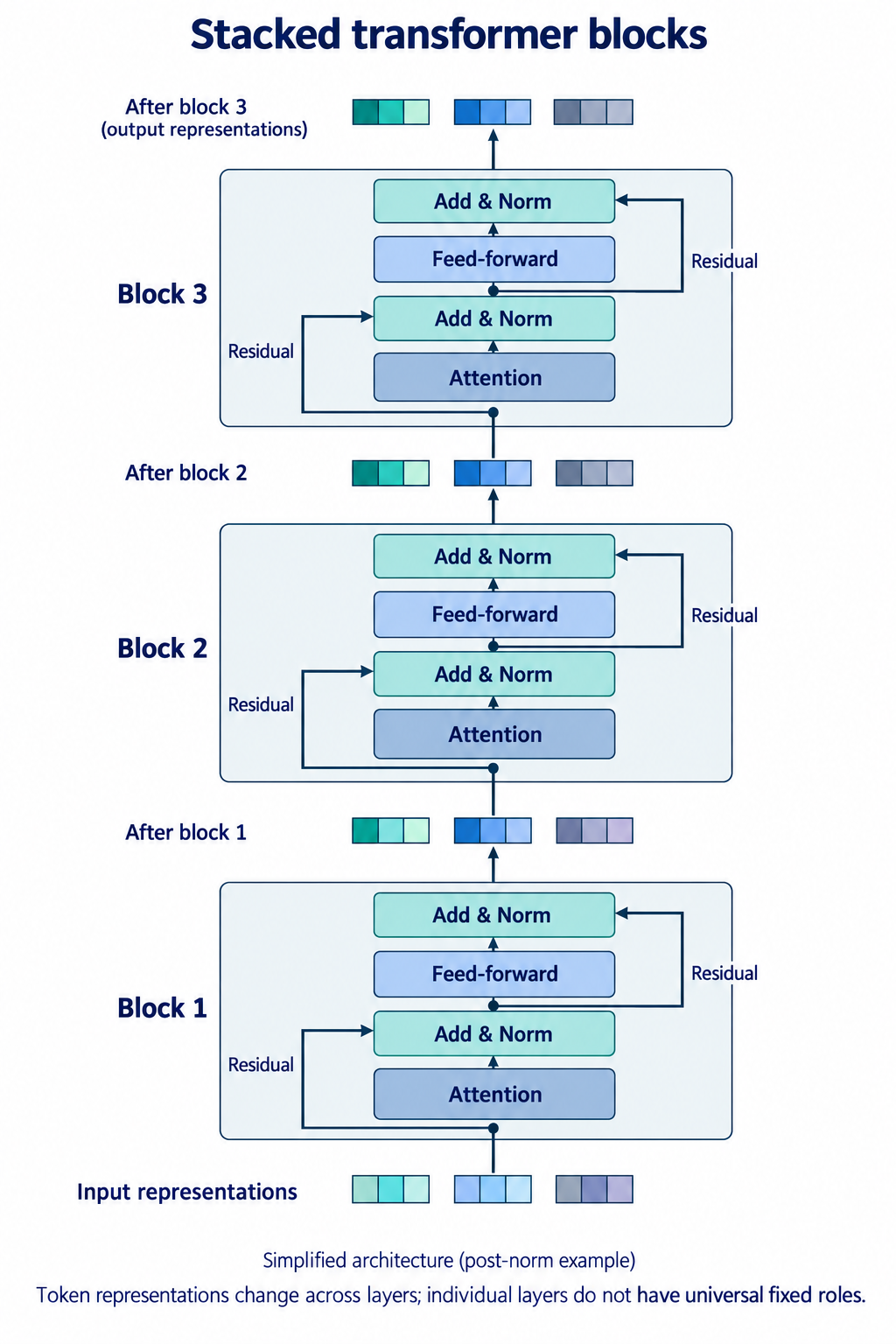
Multi-head attention allows different learned projections to process relationships in parallel. One head may become sensitive to nearby phrase structure, another to grammatical dependencies, and another to information relevant across a longer span. These are possible learned behaviors rather than fixed assignments specified by the architecture. The outputs of the heads are concatenated and passed through a learned linear projection. In the original base transformer, the attention mechanism used eight heads. Attention is followed by a position-wise feed-forward network, which applies the same learned transformation separately at each sequence position. Attention combines information across positions; the feed-forward network then transforms the resulting representation at each position through linear operations and a nonlinear activation. Residual connections add a sublayer’s input to its output, providing a direct path for information and helping gradients propagate through a deep network. Layer normalization regulates the scale of activations and supports more stable optimization. These components operate together within transformer blocks. Stacking blocks allows the output of one stage to become the input to the next, so that each stage can build on relationships represented earlier. The original encoder and decoder each contained six layers. Decoder layers also included attention to the encoder’s output, enabling the model to condition the generated translation on the source sentence. Later language models adapted these components to different objectives, sometimes using an encoder, a decoder, or a modified combination. The essential pattern remains a repeated interaction between information exchanged through attention and information transformed within each position.
Successive transformer layers allow representations to incorporate increasingly complex combinations of information. Early processing may capture local associations or frequently occurring phrases. Subsequent processing can combine those patterns with grammatical dependencies, word senses, and broader contextual relationships. This provides a useful general description, but the internal organization is not a rigid sequence in which each layer has one exclusive linguistic function. Different models distribute information differently, and several kinds of information can coexist within the same layer. Consider a sentence stating that a bank beside a river announced record profits despite an economic downturn. Interpreting “bank” requires using the financial context even though “river” appears nearby. The model must also represent the relationship between the institution and its announcement, distinguish the modifying phrase from the main clause, and account for the contrast introduced by “despite.” Repeated transformations make it possible to integrate those relationships into the representations used for prediction. Research using diagnostic probes has found that grammatical structure can be recovered from some contextual embeddings. Work by John Hewitt and Christopher Manning, for example, examined how syntactic relationships could be reflected in the geometry of those representations. Recovering information through a probe does not, by itself, establish exactly how the model uses that information, but it demonstrates that training can produce internal structure beyond isolated word associations. The original transformer was evaluated on machine translation and achieved strong results on English–German and English–French benchmarks. Its wider influence followed from the flexibility of the architecture: the same general components could support objectives other than translation. This opened a path from an architecture designed for sequence transformation to models trained on large collections of text for more general language prediction.
Generative language modeling adapted the transformer to predict the next token from preceding context. A decoder-only model uses causal attention so that each position can incorporate information from earlier positions while excluding future tokens. Training asks the model to assign high probability to the continuation observed in the data. This objective resembles the predictive principle used in earlier statistical language models, but the representation of context is substantially more expressive. A deep transformer shares learned parameters across many examples and can combine information from a much longer sequence than a short n-gram model. It does not need a separate observed count for every possible context. OpenAI’s original Generative Pre-trained Transformer, or GPT, demonstrated this approach in 2018. The model used 12 transformer layers and was trained on sequences of 512 tokens. It learned language representations through prediction and then adapted those representations to supervised tasks. Its trainable parameters included embedding values, attention projections, feed-forward weights, and other quantities controlling the computation. During training, the model’s predictions are compared with the target tokens. Backpropagation computes how changes to the parameters would affect the training loss, and an optimization algorithm updates those parameters. Repeating this process across many examples gradually changes the model’s ability to predict text. The network is not given a separate hand-written procedure for every topic or linguistic construction. Instead, the shared prediction objective encourages representations that are useful across the material encountered during training. This is the basis of generative pre-training: learn broad regularities from a large text collection before adapting the model for particular applications.
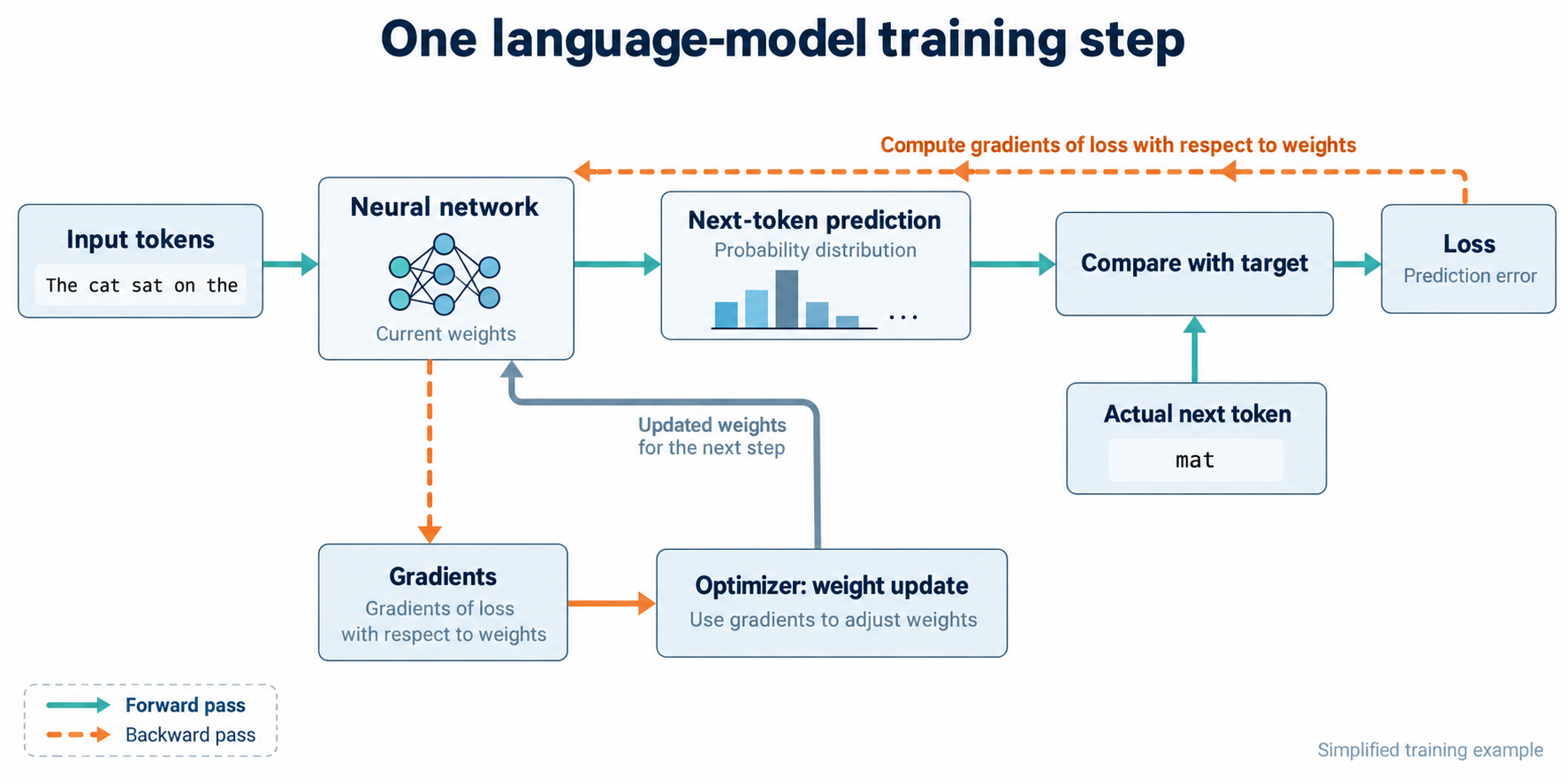
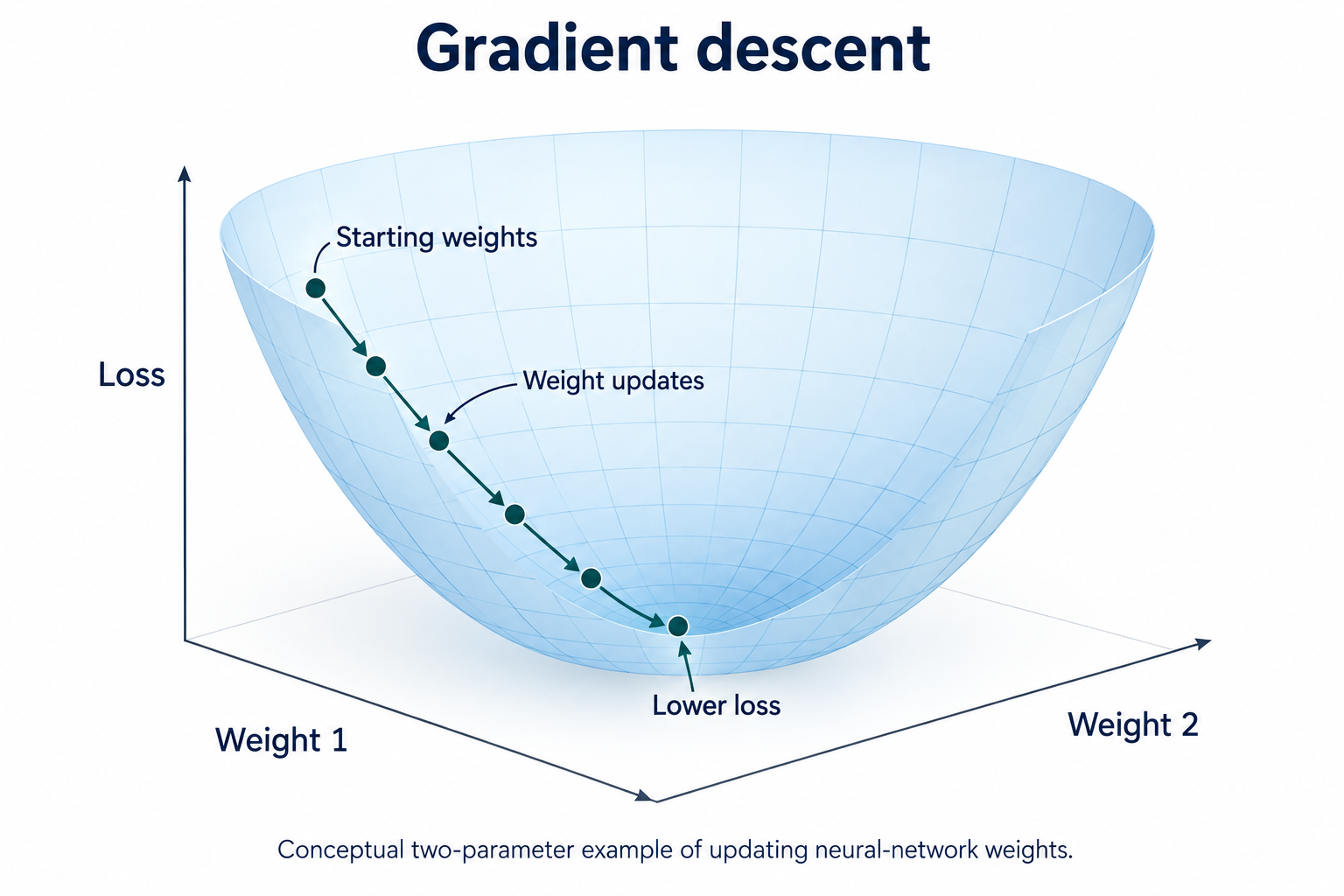
The training process can be understood as a collection of prediction tasks within each text sequence. Given the first token, the model predicts the second; given the first two, it predicts the third; and so on. In transformer training, these predictions can be calculated together using a causal mask, because the target sequence is already available and the mask prevents each position from accessing later tokens. This differs from generation, where the next token must be selected before it can become part of the context. The training loss measures how much probability the model assigns to the actual target tokens, commonly through cross-entropy. Gradient-based optimization adjusts the parameters in directions that reduce this loss, with the learning rate controlling the size of each update. Gradients calculated from that loss guide updates across a batch of examples. Over many updates, the parameters come to encode regularities that help distinguish plausible continuations from less plausible ones. The diversity of those regularities is substantial. Predicting a passage from a mystery novel can require tracking characters, objects, and events. Predicting a legal document requires sensitivity to specialized terminology and conventional forms of argument. Predicting a recipe benefits from knowledge of ingredients, quantities, and the order of preparation. These demands help explain why a single prediction objective can produce representations useful in many domains. Accurate continuation often depends on information extending beyond immediate word associations. At the same time, success on prediction does not guarantee that every relevant fact is represented correctly or that a learned relationship will generalize reliably. Training optimizes an aggregate statistical objective across a dataset. The capabilities and limitations of the resulting model reflect the interaction of that objective with the architecture, optimization process, and examples available.
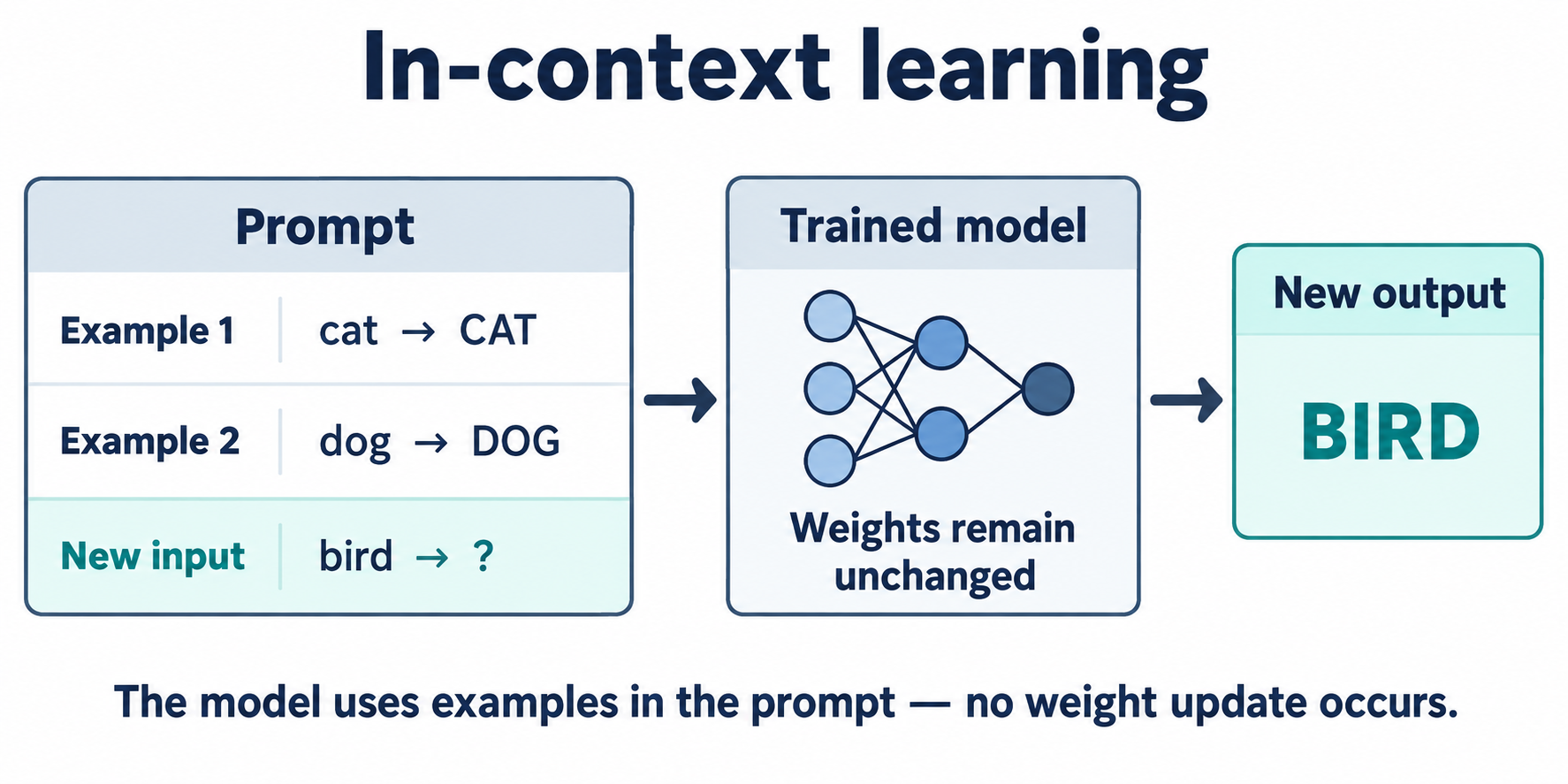
Pre-training made it possible to reuse a common set of learned representations across tasks such as classification, question answering, and reading comprehension. A model could acquire broad language patterns from unlabeled text and then be fine-tuned using a smaller collection of task-specific examples. Subsequent GPT models explored the effect of increasing model size and the breadth of training data. GPT-2, introduced in 2019, extended this approach with a model of 1.5 billion parameters trained on approximately 40 GB of text from eight million web pages. It demonstrated sustained, stylistically coherent generation from a prompt. Such fluency also made the difference between a convincing narrative and a factual account more apparent: a generated passage could adopt the conventions of a news report while supplying invented events and quotations. The staged release of GPT-2 reflected concern about possible misuse and contributed to debate over how increasingly capable generative models should be made available. GPT-3, presented in 2020, expanded the approach to 175 billion parameters and used a mixture of web, book, and reference material. One of its major research contributions was the demonstration of broad few-shot performance through examples supplied in the prompt. A prompt could present several instances of translation, summarization, or another task and then ask the model to complete a new instance. This process is called in-context learning. The model’s parameters remain fixed during the interaction; the examples influence its computation by becoming part of the context. It is therefore different from fine-tuning, which changes the model’s weights. The results showed that a general language prediction model could respond to task descriptions and demonstrations across a range of applications. They did not establish that every task was absent from the training material, nor that the model had acquired a universal method for solving unfamiliar problems. They demonstrated that learned representations and contextual conditioning could support useful adaptation without a separate parameter update for each request.
The growth of model capabilities led to sustained discussion of emergence. Some evaluations appeared to show abilities becoming measurable only after a model reached a certain scale. This encouraged comparisons with thresholds or transitions in other complex systems. However, an apparent discontinuity can also depend on the way performance is measured. A test that awards credit only for a completely correct answer may conceal gradual improvements in intermediate predictions. Research on evaluation metrics has therefore questioned whether every reported instance of emergence represents an abrupt underlying change. The practical observation remains that increasing scale and improving training can produce behavior that is difficult to anticipate from a model’s architecture alone. A complete description of the mathematical operations does not automatically provide an explanation of every capability learned through those operations. Researchers can specify the attention equations, the optimization objective, and the parameter updates while still lacking a detailed account of how a particular model solves a particular problem. One interpretation is that predicting diverse text encourages internal representations of the systems and relationships described in that text. A passage about a crime investigation may require tracking evidence and possible explanations. A passage about atomic physics may require representing relationships among physical quantities and processes. These representations can support predictions across multiple contexts, but their accuracy and scope must be evaluated rather than assumed. The relevant research question is how training converts statistical regularities into internal computations that generalize. Scale contributes to that process, alongside data quality, architecture, optimization, and the design of the task. Understanding their interaction is essential to explaining both the breadth of model performance and its uneven reliability.
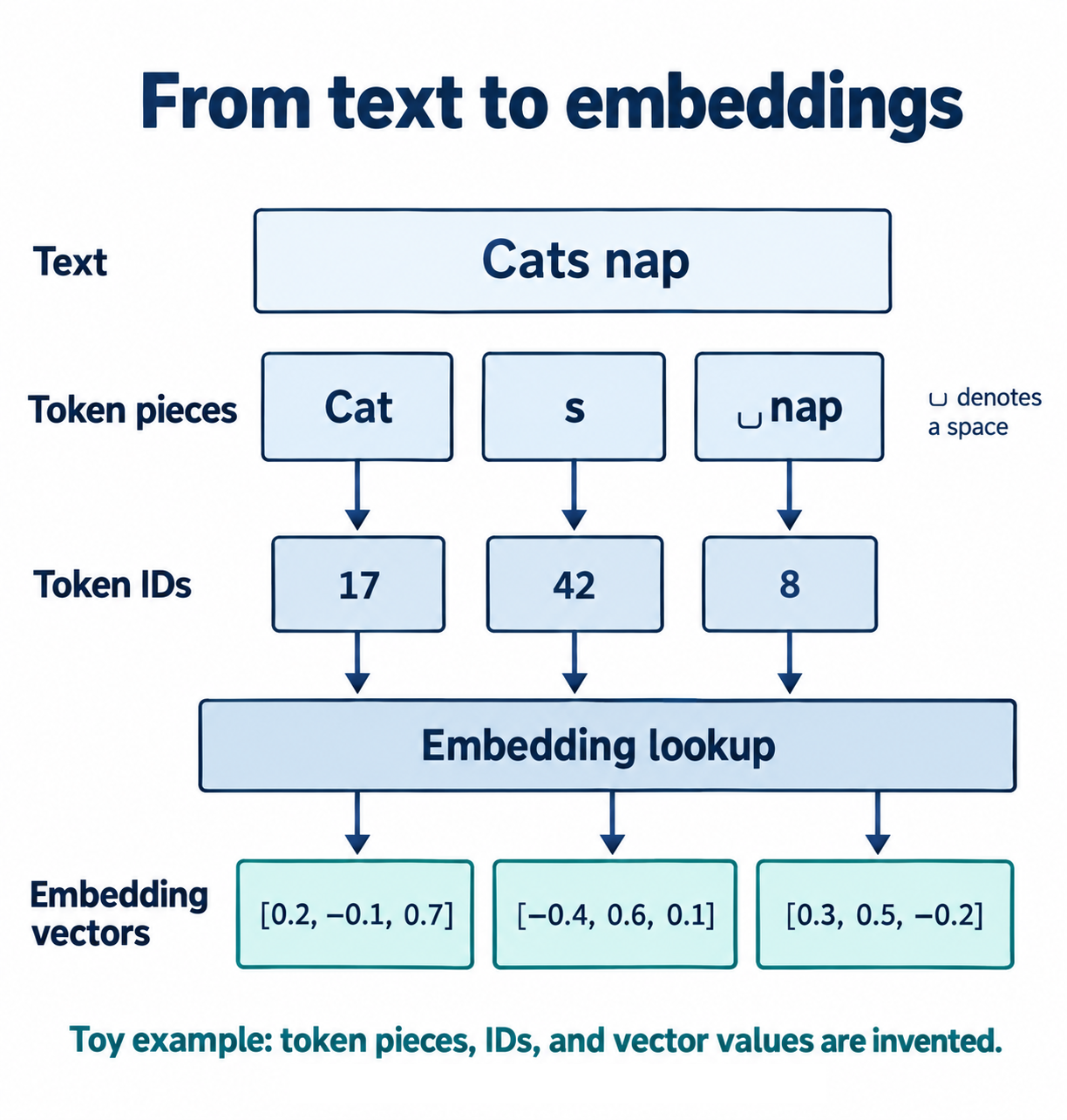
When a user submits a prompt, the first processing step is usually tokenization. The text is divided into units that may correspond to whole words, word fragments, punctuation, characters, or bytes, depending on the tokenizer. A common method is byte pair encoding, which constructs reusable units by repeatedly merging frequently occurring pairs. Related subword methods address the same practical problem: representing common expressions compactly while retaining a way to encode unfamiliar text. A rare word can be divided into smaller pieces that already belong to the vocabulary. The exact segmentation depends on the tokenizer, so a word does not necessarily correspond to one token or to a predictable set of linguistic syllables. Each token is assigned an identifier and mapped through an embedding table to a learned vector. Positional information is then incorporated according to the model’s architecture. The sequence passes through the transformer layers, where attention combines information from available context and feed-forward networks transform the representations. For an autoregressive model, causal restrictions preserve the distinction between preceding context and future text. After the final layer, the representation at the relevant output position is used to calculate scores for possible next tokens. This sequence of operations connects the user’s visible text to the numerical prediction produced by the model. Tokenization determines the units of computation, embeddings provide learned input representations, and the transformer layers construct the context on which the next prediction depends.
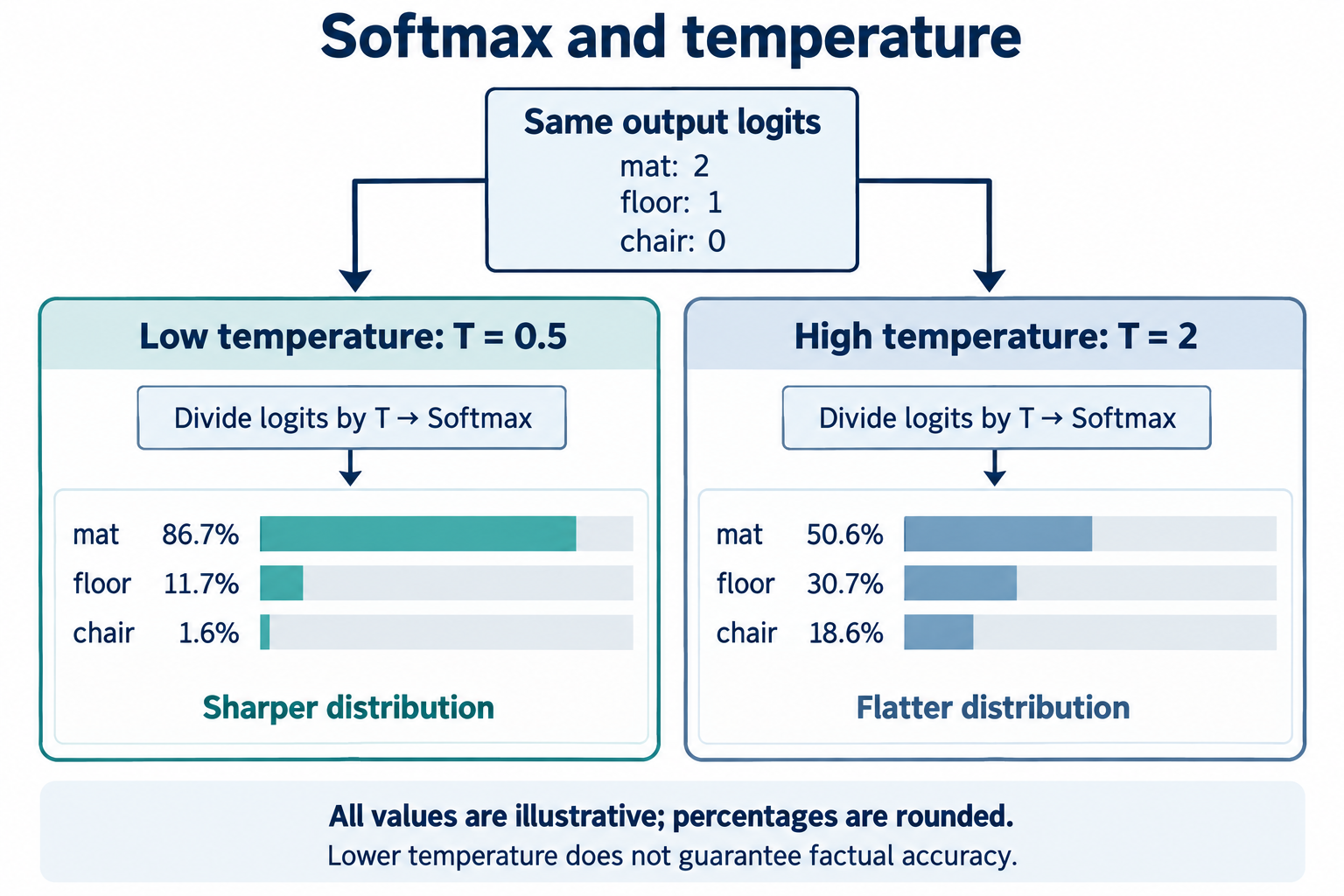
The final representation is projected into a set of scores, called logits, with one score for each token in the vocabulary. A softmax function converts these scores into a probability distribution. The probabilities describe the model’s relative preference for possible continuations given the context; they are not estimates that the statements formed by those continuations will be factually correct. A decoding procedure then selects the next token. Greedy decoding chooses the token with the highest probability at each step. Sampling instead draws from a distribution, allowing variation among possible continuations. Temperature adjusts that distribution by changing the scale of the logits before softmax. Lower positive temperatures concentrate probability on the higher-scoring choices, while higher temperatures produce a flatter distribution. A temperature setting of zero is commonly implemented as greedy selection. Other methods restrict which tokens are eligible for selection. Top-k sampling retains a fixed number of the highest-probability tokens. Nucleus sampling, also called top-p sampling, retains a set whose cumulative probability reaches a chosen threshold. The probabilities are then normalized over the retained candidates. These methods limit selection from the extreme low-probability portion of the distribution while preserving some variation. Their effects depend on the model, prompt, and task. Greater randomness can increase diversity, but it does not by itself establish originality, usefulness, or quality. Lower randomness can make responses more consistent without ensuring accuracy. A suitable decoding configuration must therefore be judged against the application: factual extraction, structured output, explanatory writing, and open-ended composition place different demands on the generated result. The selection procedure is a consequential part of system behavior, operating on the predictions produced by the trained model.
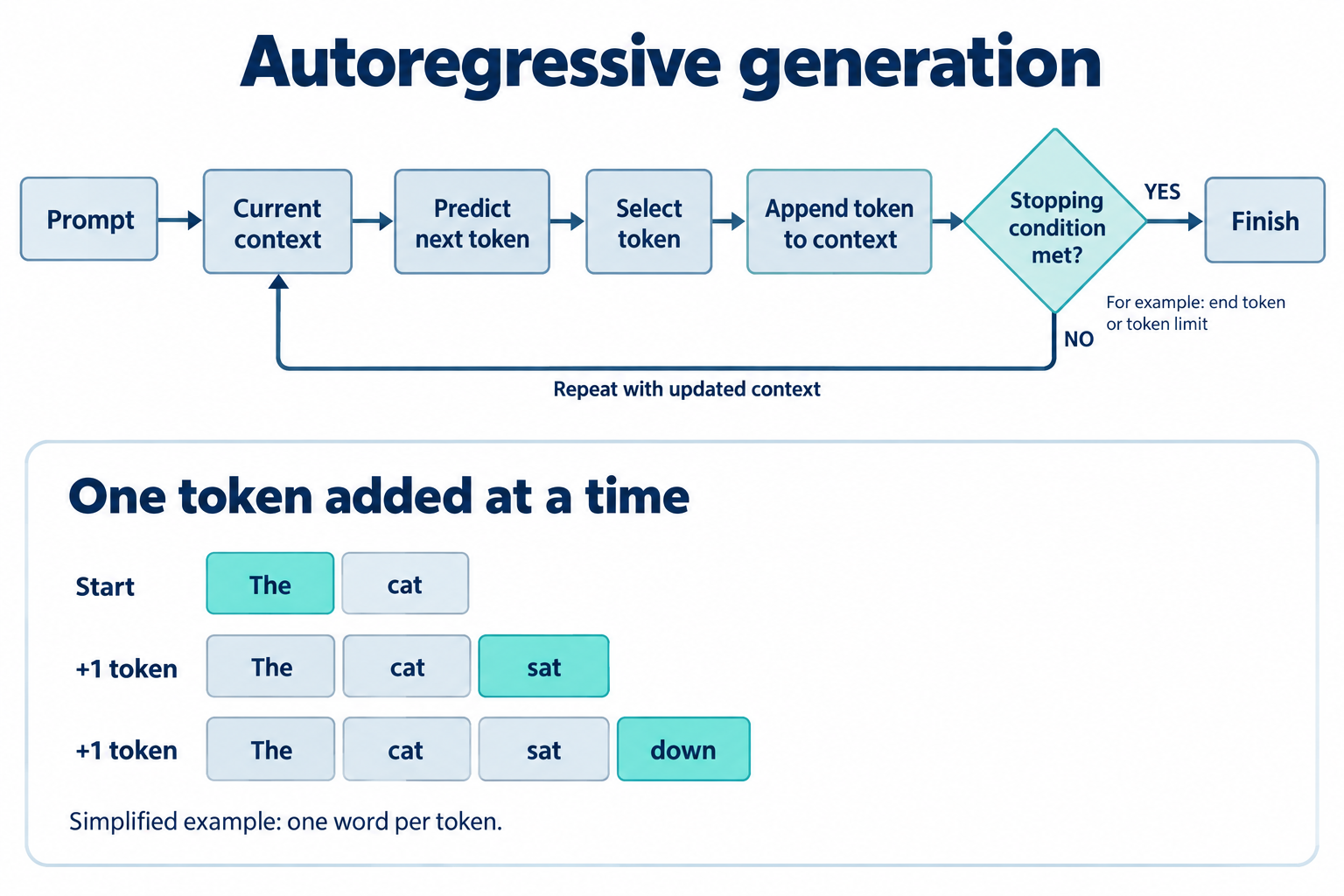
Autoregressive generation repeats this prediction and selection process one token at a time. After a token is selected, it becomes part of the context used to generate the next token. The response therefore depends on both the original prompt and the sequence already produced. Efficient implementations usually cache attention keys and values from earlier positions, reducing the need to recompute the entire preceding sequence at every step. The process continues until a stopping condition is reached, such as an end token or a configured output limit. In a basic generation pass, previously emitted tokens remain fixed. Later text may qualify or correct an earlier statement, but the underlying pass does not retroactively replace text already produced. More elaborate systems can add planning, separate reasoning stages, external tools, or revision procedures around this mechanism. These additions should be distinguished from the basic next-token generation loop. The model’s ability to produce a coherent extended response depends on how effectively its representations preserve the instructions, topic, structure, and commitments present in the available context. Each step is local in the sense that it selects the next token, but its conditioning information can include a substantial preceding passage.
A model trained to predict text does not automatically become a dependable conversational assistant. It can continue a prompt in a plausible style while failing to answer the intended question, follow instructions, or observe an application’s requirements. Post-training methods are used to shape these behaviors. Supervised fine-tuning provides examples of desired responses, teaching the model to associate instructions with useful forms of completion. Reinforcement learning from human feedback, or RLHF, adds a preference-based training signal. In a common approach, the model generates several responses to a prompt and human evaluators compare them according to criteria such as helpfulness, accuracy, and appropriateness. Those comparisons train a reward model that estimates which responses evaluators would prefer. A reinforcement learning procedure then updates the language model to favor responses receiving higher reward, usually with constraints intended to limit undesirable departures from the starting model. Proximal policy optimization, or PPO, has been used for this stage. The reward signal allows evaluative judgments to influence a much larger set of training interactions than humans could individually review. For example, a base model may continue a question as part of a discussion about questions, while an assistant trained on demonstrations and preferences is more likely to answer it directly. The underlying ability to generate language comes from pre-training; post-training shapes how that ability is expressed in interaction. RLHF is one influential approach among several, and conversational behavior should not be attributed to it alone. Instruction examples, the training mixture, system instructions, and other optimization methods can also affect the result. Together, these components influence whether the system responds in a way that is relevant to the user’s request and suitable for its intended role.
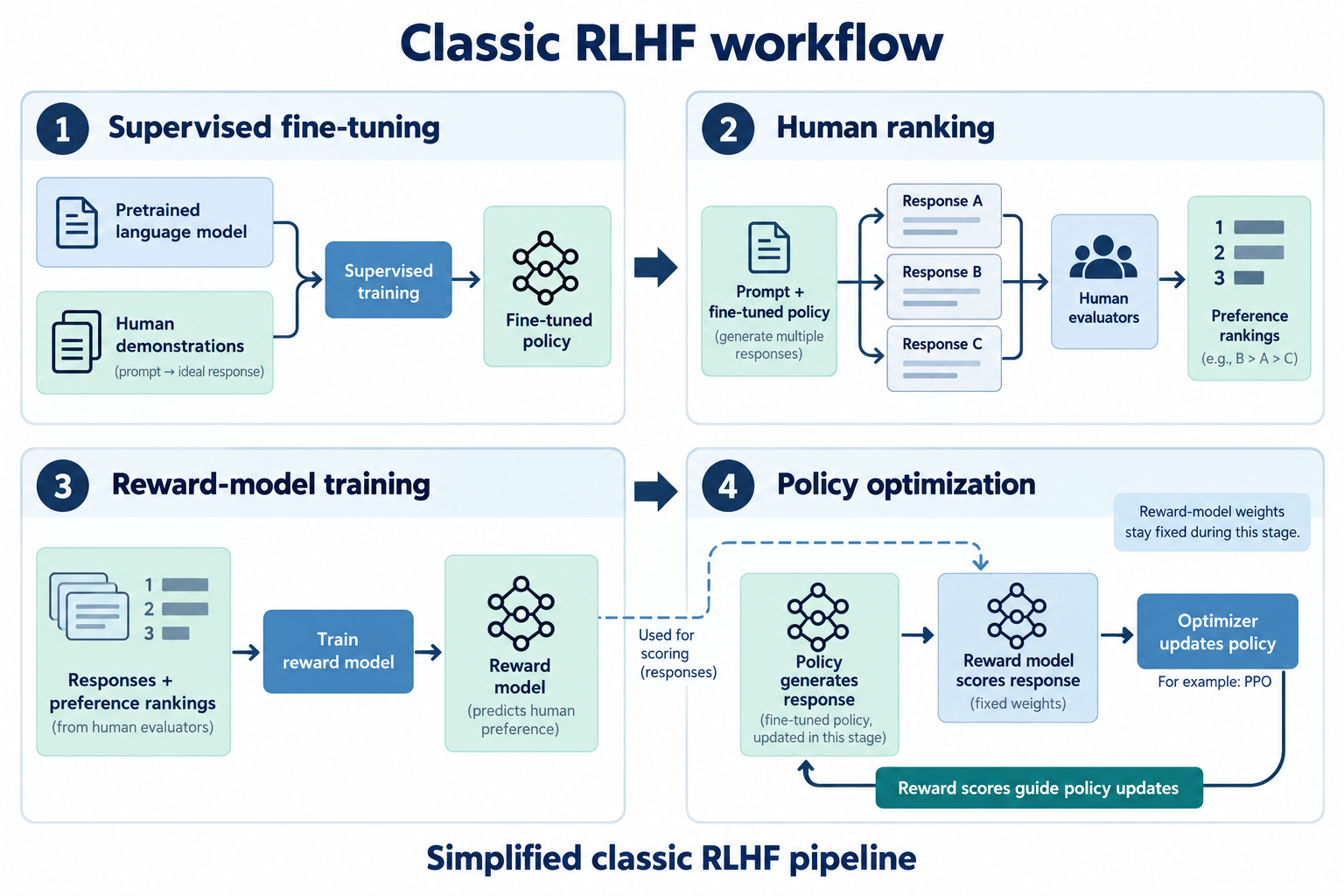
Training against human preferences introduces its own limitations. A reward model approximates the judgments represented in its training data; it cannot provide a complete or universally agreed definition of good behavior. Evaluators may disagree about tone, usefulness, acceptable uncertainty, or the appropriate treatment of sensitive material. Their judgments can also favor a polished response over a more accurate but less persuasive one. Optimization may amplify weaknesses in the reward signal, producing confident wording, excessive agreement, or other features that score well without satisfying the underlying objective. This broader problem is often described as reward hacking or specification gaming: a system improves the measured criterion while failing to achieve the intended result. In language systems, the distinction between perceived quality and verified correctness is especially consequential because fluent explanations can conceal unsupported claims. Constitutional AI explores an additional method for guiding behavior through an explicit set of principles. In this approach, a model can critique and revise responses according to those principles, and AI-generated evaluations can contribute to subsequent training. Human choices remain central in selecting the principles, designing the process, and evaluating its results. Such methods can reduce the amount of individual human labeling required and make some behavioral objectives more explicit. They do not remove disagreements over those objectives or guarantee that the model will apply them correctly in every situation. Reliable alignment requires evaluation of actual behavior, including cases in which the apparent quality of a response diverges from its substantive accuracy or usefulness.
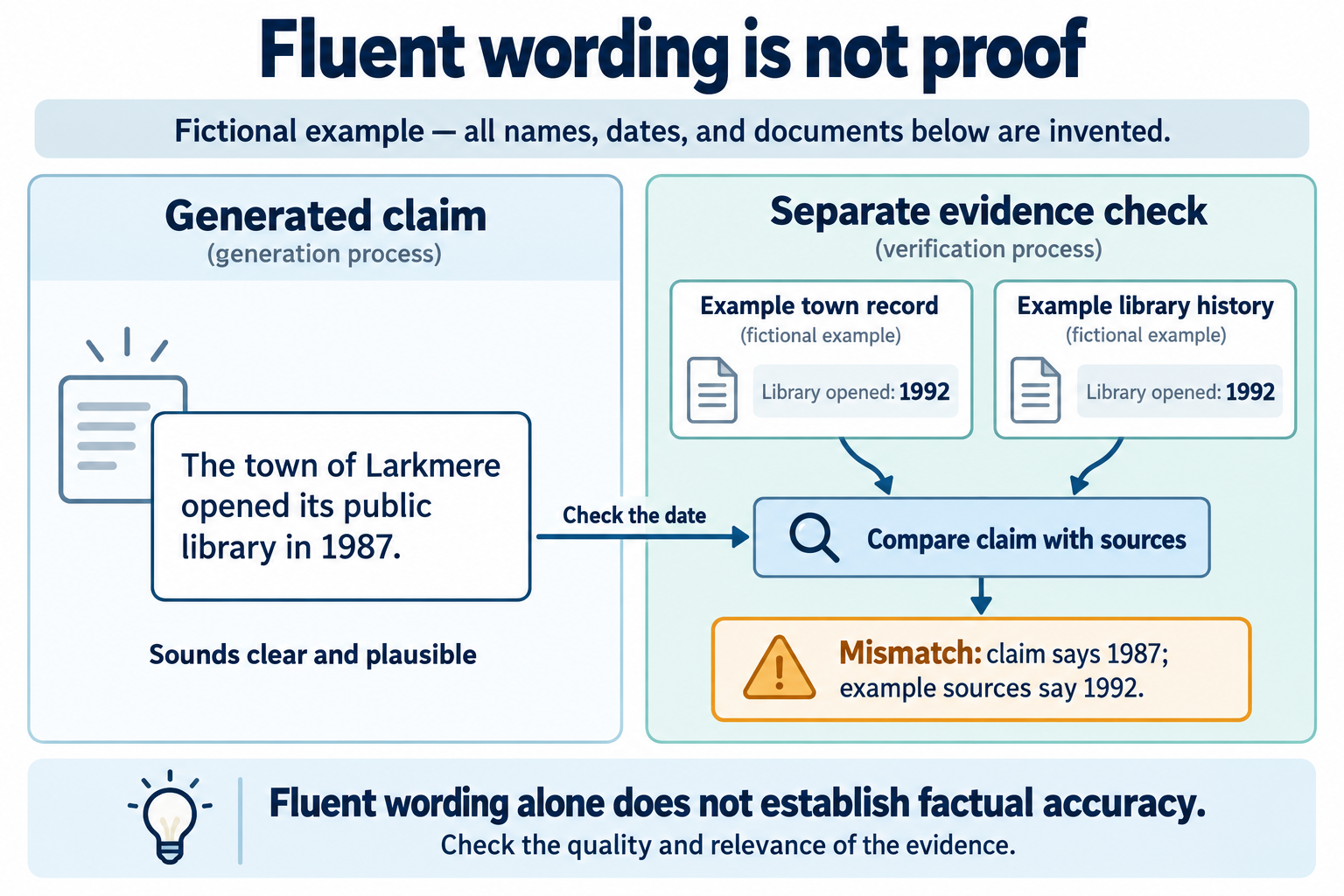
One of the clearest examples of that divergence is hallucination: the generation of information that is false, unsupported, or inconsistent with the relevant evidence. A model may produce a nonexistent research paper with plausible authors and publication details, misattribute a quotation, or combine information about several people into an inaccurate biography. The same fluency that makes a correct explanation useful can make an invented account appear authoritative. The prediction objective helps explain this vulnerability. In an unaided generation step, the model calculates a continuation from its learned parameters and current context. That calculation does not inherently compare every claim with an external record. Familiar patterns in scientific writing, biographies, or legal argument can be reproduced even when a particular name, event, or citation is not reliably represented. Training data may also contain contradictions, outdated information, mistakes, and fictional material. Post-training can encourage truthful responses and appropriate expressions of uncertainty, but it does not ensure perfect factual discrimination. Describing every such error as intentional deception would assign a motive that the error itself does not establish. Conversely, claiming that a model has no representation of truth or factual relationships goes beyond what hallucination alone demonstrates. The practical issue is that a plausible answer can be generated without adequate support. Systems equipped with search, databases, or other tools can consult external evidence, yet they must still retrieve relevant material, interpret it correctly, and keep their response consistent with it. A successful retrieval step is therefore helpful without being sufficient by itself. The resulting pattern of strengths and weaknesses can be difficult to assess: a model may solve a complex programming problem and then fail a comparatively simple counting or reference task. Performance in one setting should not be treated as a general guarantee of reliability. Evaluation must examine the specific task, the available evidence, and the kinds of errors that matter in use.
Research on internal representations provides evidence that at least some language models learn structure beyond immediate associations between visible symbols. Research by Kenneth Li and colleagues involving the board game Othello, for example, trained models on sequences of moves and investigated whether their internal activations represented the underlying board state. The results supported the presence of information corresponding to the game’s spatial configuration, despite the model receiving move sequences rather than an image of the board. Such findings make it possible to study whether a model develops an internal representation of a system described by its inputs. They do not establish that every model constructs an accurate general account of the physical or social world. The extent and reliability of these representations remain empirical questions. This research is also relevant to the broader debate over whether language models understand what they discuss. A system may explain a concept, solve a multi-step problem, or produce working code while also making errors that reveal gaps in its handling of the same subject. The philosophical question cannot be settled by fluency alone, and researchers do not share a single operational definition of understanding. John Searle’s Chinese room thought experiment illustrates one aspect of the debate. A person who does not know Chinese follows instructions for manipulating Chinese symbols, producing responses that appear appropriate to an outside observer. Searle used the example to argue that formal symbol manipulation is insufficient for understanding. Critics have challenged that conclusion, including whether the appropriate object of analysis is the person or the complete system. Learned neural models add further questions because their internal representations arise through training rather than through an explicitly written response manual. Their ability to encode relationships is relevant evidence about their computation, but it does not independently resolve questions of consciousness or subjective experience. A careful account distinguishes demonstrable capabilities, measurable internal structure, and philosophical interpretations of what those findings imply.
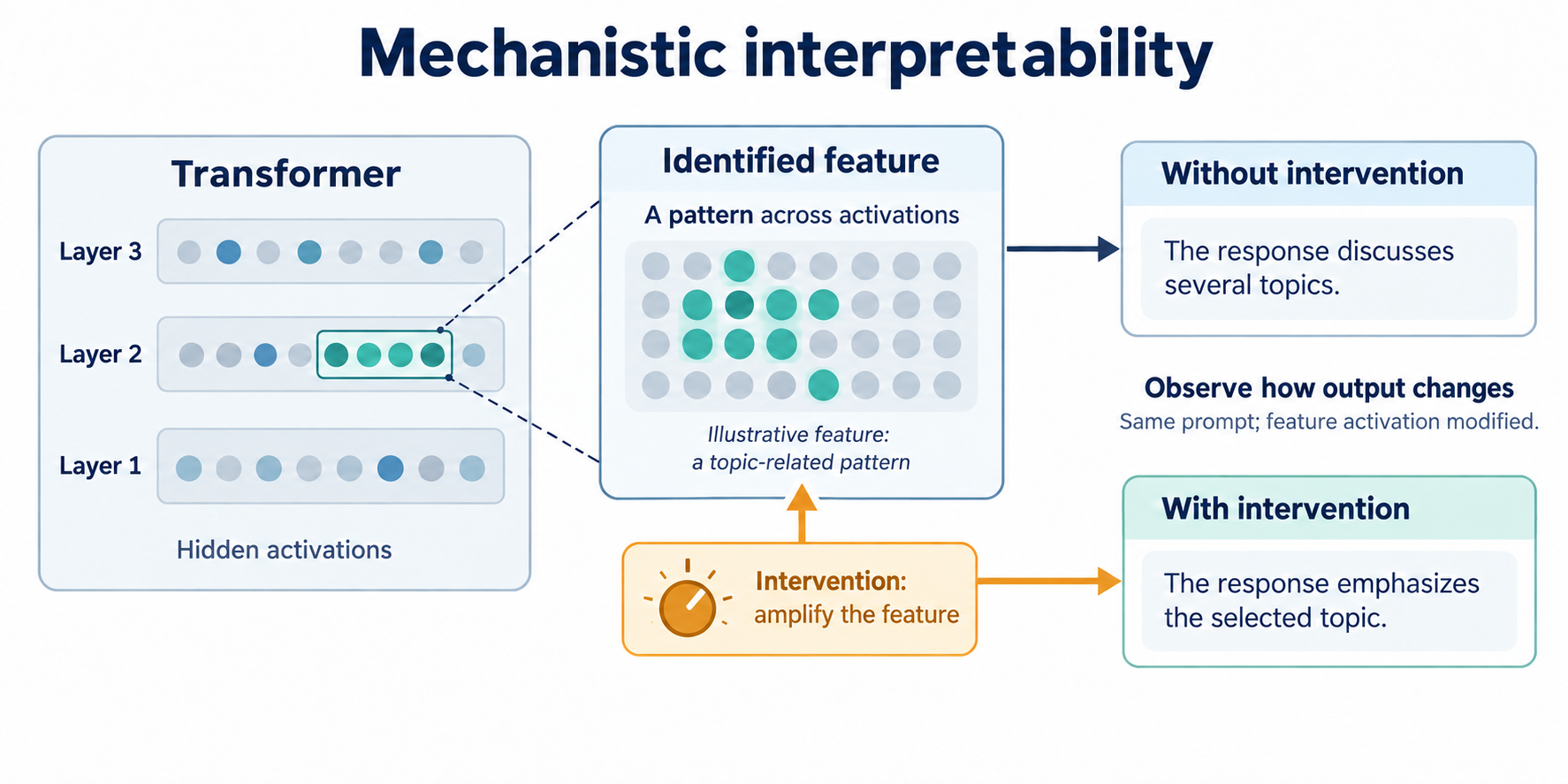
Interpretability research seeks to connect a model’s observable behavior with the computations and representations that produce it. The architecture and parameter values may be available, yet their detailed functional organization can remain difficult to explain. Researchers therefore investigate which features are represented in activations, how information moves through attention and feed-forward layers, and which internal components contribute to particular outputs. Mechanistic interpretability aims to identify these causal relationships at a more detailed level than a description of overall input and output behavior. Some work has identified features associated with topics, entities, styles, or other recurring properties. Other work has examined circuits: interacting components that support a particular computation in a studied setting. Experiments can go beyond detecting a correlation by altering an internal feature and measuring the resulting change in behavior. In Anthropic’s work on learned features, strengthening a feature associated with the Golden Gate Bridge increased the model’s tendency to bring that subject into its responses. This kind of intervention provides evidence that the identified representation participates in the computation affecting the output. It does not imply that an entire concept is stored in a single isolated location or that the rest of the model has been explained. Neural representations can overlap, interact, and serve different functions across contexts. Interpretability results must therefore be assessed for their scope and for whether they remain valid beyond the examples used to obtain them. The long-term objective is to improve the ability to diagnose failures, evaluate internal mechanisms, and understand why changes to a model produce changes in behavior. Progress in this area can support reliability and oversight, while the complexity of large models continues to limit how comprehensively their operation can be explained.
The computational infrastructure behind language models is a major part of their practical development. Training requires repeated matrix operations across large numbers of parameters and examples. Graphics processing units and other AI accelerators are suited to these workloads because they can execute many numerical operations in parallel. Large training systems combine accelerators through high-speed interconnections, with substantial requirements for memory, data movement, storage, and coordination. Their physical operation also requires electricity and cooling. The cost of a training run depends on far more than parameter count: the amount of training data, numerical precision, hardware utilization, communication overhead, and optimization choices all contribute. Serving a trained model introduces a separate computational workload that grows with use and with the amount of text processed or generated. These constraints make efficiency central to both research and deployment. Work on scaling laws, including research by Jared Kaplan and colleagues, examined empirical relationships among model size, dataset size, computational expenditure, and language prediction loss. Within the settings studied, performance often followed relatively regular trends as resources increased. These findings helped researchers plan training runs and estimate the consequences of different allocations of compute and data. They do not imply that every capability improves at the same rate or that additional scale resolves every limitation. A lower prediction loss can coexist with factual errors, fragile reasoning, and difficulty on unfamiliar tasks. The question is therefore broader than whether larger models produce better average predictions. It includes which capabilities improve, what those improvements cost, and which failures require changes in data, architecture, objectives, or surrounding systems. The relationship between scale and useful performance remains a central consideration in evaluating the future development of language models.
The deployment of language models extends these technical questions into education, employment, publishing, software development, and public policy. Their use in writing and assessment affects how institutions define independent work and evaluate learning. Their use in hiring or other consequential decisions raises questions about bias, transparency, and accountability. Generated reporting and social content require decisions about attribution and how readers can assess supporting evidence. Generated software creates responsibilities for testing, maintenance, and security review. Governments and institutions have responded through differing approaches to regulation, organizational policy, and oversight, reflecting differences in legal systems and priorities. Technical development also extends beyond simply increasing model size. Retrieval-augmented generation supplies relevant documents or other external information as context, helping the system base its answers on accessible evidence. Explicit intermediate reasoning can improve performance on some tasks, although a written reasoning sequence is not a guarantee of correctness or a complete explanation of the model’s internal computation. Mixture-of-experts architectures activate selected components for each input, allowing total model capacity to grow without requiring every parameter to participate in every calculation. State-space architectures, including Mamba, and hybrid designs explore other ways to process long sequences and manage computational cost. All of these approaches ultimately depend on semiconductor hardware, whose performance and manufacturing constraints influence what can be trained and deployed. Another limitation concerns the relationship between training data and current information. A trained model’s parameters reflect the material and training stages used to construct it. New events do not automatically update those parameters during an ordinary conversation. Recent information can be supplied through the prompt, retrieval, or tools, but that information must be distinguished from knowledge acquired during training. The selection of training material also affects whose perspectives, languages, and assumptions are represented, making data curation consequential for both capability and bias. These considerations connect technical design with economic and geopolitical choices about investment, access to hardware, research priorities, and control of infrastructure. Forecasts concerning artificial general intelligence remain disputed, in part because definitions and proposed measures differ. Preparing for future capabilities therefore requires separating demonstrated performance from extrapolation. The development of statistical language models, the transformer, and conversational assistants establishes a record of substantial progress; it does not establish a precise timetable for every proposed future capability. Questions about intelligence, safety, work, creativity, and the distribution of benefits remain open and require evidence as well as technical experimentation.
The development of large language models shows how a relatively simple prediction objective can support a wide range of learned behavior when combined with suitable representations, architectures, data, and computational resources. The individual operations are familiar mathematical transformations: multiplication, addition, nonlinear functions, and comparisons among vectors. Their organization and training enable patterns that extend from local word relationships to more elaborate structures relevant to explanation, translation, coding, and other tasks. This progression can be traced through several distinct contributions. Shannon demonstrated the statistical structure of language. Research on learned word embeddings showed how patterns of use could be represented geometrically. Recurrent networks provided mechanisms for processing sequences, while attention improved access to information across positions. Transformers made attention a central organizing component and supported more effective parallel training. Generative pre-training and subsequent work on instruction following and feedback broadened the practical use of these models. These developments also depended on the wider history of neural network research, including sustained work on representation learning and the training of deep networks by researchers such as Geoffrey Hinton and many others. The result is a technology whose mathematical construction can be described in detail, while a complete account of its learned internal behavior remains an active research objective. Apparent understanding, demonstrable task performance, and human-like experience are separate questions and should be evaluated with appropriate evidence. Persistent limitations include hallucination, inconsistent reasoning, incomplete interpretability, bias, and the substantial resources required for training and use. Institutional questions include accountability, access, and the concentration of technical and economic power. These limitations form part of the same account as the technology’s achievements. A useful understanding of language models must explain what enables their performance and what constrains it. The central conclusion is that patterns in language provide a rich basis for learned representations, but the ability to generate plausible language does not eliminate the need to evaluate meaning, evidence, and reliability. Future progress will depend on improving both the capabilities of these systems and the methods used to understand and assess them.